
Working at sea is one of the most unique and rewarding careers in the world, but it also comes with distinct challenges. When you are on a merchant ship, you are thousands of miles away from immediate shore assistance. You face unpredictable weather, manage heavy machinery, and work alongside a diverse team. In this environment, safety and operations are not just guidelines in a handbook. They form the core foundation that protects your life, your crewmates, your cargo, and the marine environment.
Whether you are a cadet, a GP Rating trainee, or an aspiring officer from India, understanding how safety and operations work together is essential for a successful maritime career.
Table of Contents
Why Safety is Crucial in the Merchant Navy
Safety at sea is a daily habit that you must practice continuously. Ships operate 24 hours a day and 7 days a week. Unlike shore jobs, you cannot simply walk away from a dangerous situation or call local emergency services for quick help. External aid might be hours or even days away.
A strong safety culture on board leads to specific benefits:
- It drastically reduces the risk of accidents and injuries.
- It builds smooth teamwork across all onboard departments.
- It improves overall operational efficiency.
- It ensures your ship complies with international maritime laws.
- It helps you earn senior respect and advances your maritime career.
Ignoring safety protocols puts everyone on board at risk. Ships face severe hazards daily, such as sudden sea storms, machinery breakdowns, oxygen depleted spaces, fuel fires, and dangerous cargo handling. Maintaining strict discipline keeps these risks under control.
Understanding Onboard Operations and Onboard Departments
Shipboard operations cover all the daily duties and routines required to keep a vessel secure, fully functional, and legally compliant. Every department on a merchant ship has distinct responsibilities, yet they all work toward the same primary objective: protecting life, cargo, the vessel, and the environment.
The Deck Department
The deck team handles navigation, vessel stability, cargo handling, and overall deck maintenance.
- Bridge Watchkeeping and Navigation: You monitor radars, Electronic Chart Display and Information Systems (ECDIS), and maintain a vigilant lookout to prevent collisions with other vessels.
- Mooring Operations: You secure the ship to docks or buoys using heavy ropes and wires. This is one of the most hazardous jobs on deck, requiring you to stay clear of dangerous snap back zones.
- Cargo Operations: You oversee the loading, stowing, and discharging of goods, whether managing crude oil on tankers, dry bulk on bulk carriers, or containers on box ships.
The Engine Department
The engine team keeps the ship’s mechanical and electrical power plant running smoothly. Engine cadets and junior engineers work around the clock in hot and noisy environments.
- You perform machinery watchkeeping to monitor running parameters.
- You maintain main propulsion engines, auxiliary generators, pumps, air compressors, and boilers.
- You operate purifiers, separators, and fuel oil systems.
- You record accurate readings in engine logbooks and report any unusual noise or vibration to senior engineers immediately.
The Electro-Technical Department
The Electro-Technical Officer (ETO) manages complex electrical equipment, automation systems, navigation electronics, and high voltage power distribution across the ship.
Essential International Maritime Regulations
International maritime bodies enforce strict global standards to ensure uniform safety and environmental protection across all oceans. You must learn these fundamental conventions thoroughly.
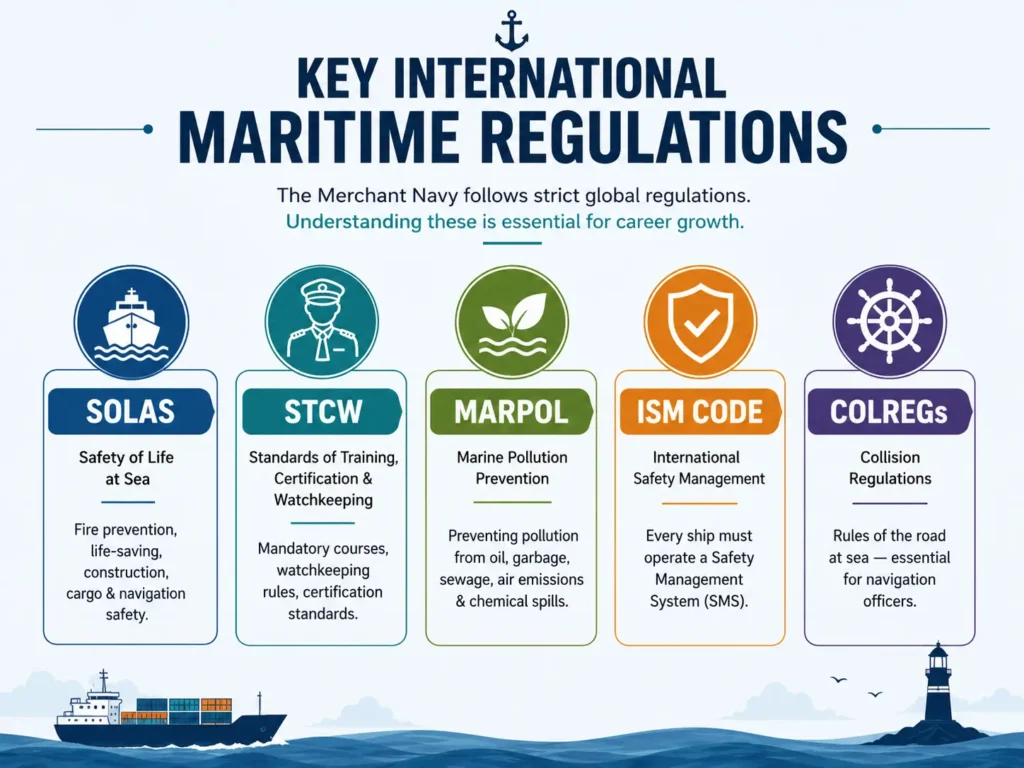
SOLAS (Safety of Life at Sea)
SOLAS is the most critical international maritime safety convention. It specifies minimum standards for ship construction, equipment, and operation. It governs fire safety systems, life saving appliances, ship stability, navigation systems, and mandatory emergency drills.
STCW (Standards of Training, Certification & Watchkeeping)
STCW sets qualification standards for seafarers worldwide. It mandates basic safety training courses, including Personal Survival Techniques (PST), Fire Prevention and Fire Fighting (FPFF), Personal Safety and Social Responsibilities (PSSR), and Elementary First Aid (EFA). It also sets watchkeeping rules and certification steps.
MARPOL (International Convention for the Prevention of Pollution from Ships)
MARPOL aims to eliminate marine pollution from ships. It regulates the discharge of oil, noxious liquid substances, sewage, garbage, and air emissions from engine exhausts.
ISM Code (International Safety Management Code)
The ISM Code requires shipping companies to implement a Safety Management System (SMS) on every vessel. This system provides clear protocols for safe ship operation, risk assessment, near miss reporting, and emergency readiness.
COLREGs (International Regulations for Preventing Collisions at Sea)
COLREGs provide the basic rules of the road for vessels at sea. Navigation officers must follow these guidelines to avoid close quarters situations and collisions.
Recommended Read: Understanding Maritime Insurance: Guide to Your Legal and Commercial Rights
The Permit to Work (PTW) System
High risk tasks on board require formal permission before work begins. The Permit to Work (PTW) system is a documented procedure that identifies potential hazards and outlines necessary safety precautions. You must never start a hazardous job without a signed permit from an authorized officer.
Key safety permits include:
- Hot Work Permit: Required for jobs involving open flames, welding, cutting, or grinding near flammable materials.
- Enclosed Space Entry Permit: Required before entering spaces like ballast tanks, cargo holds, or fuel tanks.
- Electrical Isolation Permit: Required to isolate electrical power sources before working on high voltage machinery.
- Working Aloft Permit: Required when performing tasks at a height, such as on masts or crane structures.
- Working Overside Permit: Required when working over the ship side above water.
Personal Safety Practices and Equipment
Protecting yourself begins with wearing proper Personal Protective Equipment (PPE) suited to your task. Standard PPE includes safety helmets, steel toe safety shoes, boiler suits, heavy duty gloves, reflective vests, and safety harnesses. You must also wear eye and hearing protection in high noise or high risk areas like the engine room.
Enclosed Space Safety Procedures
Enclosed spaces are oxygen deficient or toxic atmospheres that rank among the leading causes of shipboard casualties. You must follow strict steps before entering any enclosed space:
- Ventilate the space thoroughly using mechanical blowers.
- Test the atmosphere using calibrated gas meters to check oxygen levels, toxic gas levels, and flammable gas presence.
- Post a dedicated standby person at the entrance equipped with clear communication tools.
- Carry portable gas monitors while inside the space.
- Maintain continuous radio contact with the deck watch team.
Never enter an enclosed space without official clearance and an approved permit.
Housekeeping and Hazard Prevention
Maintaining clean work areas prevents common injuries. Keeping decks free of oil spills, securing loose tools, clearing walkways, and coiling lines properly eliminates the risk of slips, trips, and falls. A clean ship is always a safer ship.
Emergency Preparedness and Life Saving Appliances
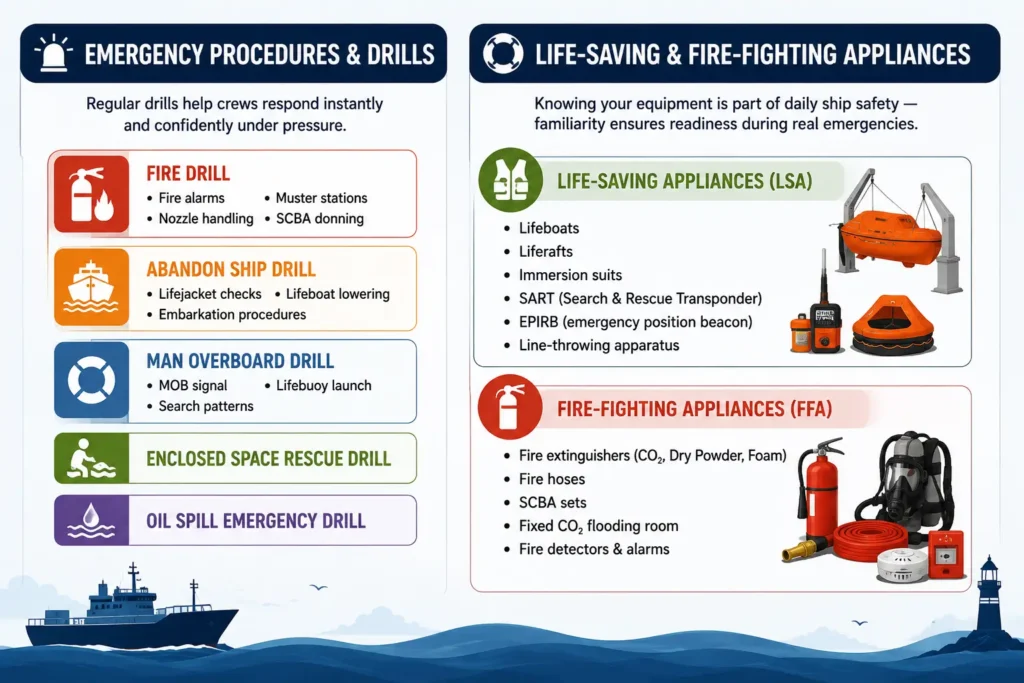
When emergencies occur at sea, your training determines the outcome. Ships conduct weekly and monthly drills to train your physical response so you can react calmly under pressure.
Essential Emergency Drills
- Fire Drills: Practice sounding alarms, assembling at muster stations, operating fire hoses, and donning Self Contained Breathing Apparatus (SCBA) suits.
- Abandon Ship Drills: Focus on wearing immersion suits, checking lifejackets, and understanding lifeboat launch procedures.
- Man Overboard (MOB) Drills: Train crews to launch lifebuoys quickly, signal the bridge, and execute search and rescue maneuvers.
Onboard Safety Appliances
You must know where safety equipment is stored and how to operate it instantly. Life Saving Appliances (LSA) include lifeboats, inflatable liferafts, immersion suits, Search and Rescue Transponders (SART), and Emergency Position Indicating Radio Beacons (EPIRB). Fire Fighting Appliances (FFA) include portable CO2, foam, and dry powder extinguishers, main fire pumps, and fixed engine room fire suppression systems.
Building a Strong Onboard Safety Culture
Safety is not the sole responsibility of the Captain or the Chief Engineer. Every single crew member plays an active role in maintaining a safe work environment.
You can contribute to a positive safety culture by:
- Attending and participating actively in pre-job toolboard meetings and safety briefings.
- Reporting all near misses and unsafe conditions immediately without fear.
- Maintaining open communication with senior officers and team members.
- Following established Safety Management System (SMS) procedures consistently.
- Politely correcting unsafe actions when you notice a crewmate making a mistake.
Practical Tips for New Seafarers
Starting your maritime career is an exciting journey. Here are practical ways to adapt smoothly during your early contracts:
- Learn from Experienced Seniors: Pay attention to senior officers, ask relevant questions, and follow instructions precisely.
- Focus on Physical Fitness: Life at sea requires physical endurance, balance, and mental alertness during long watches.
- Speak Up Early: If a task looks dangerous or if you feel unsafe, inform your supervisor immediately.
- Study Your Ship: Review the vessel’s arrangement plans, piping systems, and safety manuals during your personal time.
- Keep Certification Updated: Track your STCW certificates and medical checkup renewal dates carefully to maintain smooth employment.
Recommended Read: What is GMDSS – Global Maritime Distress and Safety System
FAQs
1. What basic safety courses must I complete before joining my first merchant ship?
You must complete mandatory STCW basic safety training courses covering Personal Survival Techniques (PST), Fire Prevention and Fire Fighting (FPFF), Elementary First Aid (EFA), and Personal Safety and Social Responsibilities (PSSR).
2. Why is entering an enclosed space without a permit so dangerous?
Enclosed spaces can contain toxic gases or lack sufficient oxygen, which can cause sudden unconsciousness or fatal suffocation within seconds.
3. What should I do if I notice an unsafe work practice on deck or in the engine room?
You should stop the unsafe activity immediately if safe to do so and report the hazard to your senior officer or supervisor.
4. How often do seafarers participate in emergency drills on board?
Ships conduct emergency drills like fire and abandon ship scenarios weekly or monthly as mandated by SOLAS regulations.
5. What is the primary purpose of the Safety Management System (SMS)?
The SMS provides a structured operational framework to ensure safe ship management practices and prevent harm to personnel, vessels, and the environment.
