
When you are out at sea, thousands of miles away from the nearest coast, your primary connection to safety is your communication setup. If an emergency occurs, you cannot simply call for help using a normal mobile phone. You need a reliable network that guarantees your call reaches the right people immediately. This is exactly what the Global Maritime Distress and Safety System does.
Table of Contents
What is GMDSS?
GMDSS is an internationally recognized safety system that uses satellite and terrestrial radio communication technologies. It ensures that any ship in distress can send an alert from anywhere across the globe. It is a completely integrated network that connects ships with shore based rescue centers and other vessels in the vicinity.
Why was it introduced?
Before this system existed, ships depended heavily on Morse code and manual listening watches on specific radio frequencies. This setup had massive limitations. If a ship was too far out at sea, its signals might not reach anyone. If the radio operator was away from the station or injured during an accident, the distress call might never be sent. The international community realized that maritime safety needed a system that did not rely purely on human intervention to receive or transmit an alert.
Brief history of maritime distress communication
For decades, maritime communication relied on the wireless telegraphy system pioneered by Guglielmo Marconi. The sinking of the Titanic in 1912 showed how critical radio communication was, leading to the creation of the Safety of Life at Sea convention. For a long time, ships used the 500 kHz frequency for Morse code and later the 2182 kHz frequency for voice communication.
However, these systems suffered from bad weather interference and limited range. In 1992, the International Maritime Organization officially rolled out GMDSS, and it became fully mandatory for commercial ships by 1999.
Importance of GMDSS in modern shipping
Today, this system is the backbone of ocean safety. It removes the guesswork from search and rescue operations. By automating distress alerts and utilizing satellite tracking, it ensures that help can be coordinated within minutes of an emergency. For us as seafarers, understanding this system is not just about passing an exam, it is a critical skill that could save your life and the lives of your crew.
What is GMDSS?
Full form of GMDSS
GMDSS stands for Global Maritime Distress and Safety System.
Main objective
The primary goal of the system is to automate distress alerting and make it impossible for a ship to disappear without a trace. It ensures that whenever a maritime accident occurs, a distress alert will be received by shore based rescue authorities and nearby ships, allowing for a coordinated rescue effort.
How it improved safety compared to traditional radio systems
Traditional systems were ship to ship systems. This meant that if you were in trouble, you had to hope that another vessel was close enough to hear your voice call or Morse code message. If no ship was nearby, your signal vanished. GMDSS changed this completely by making the system primarily ship to shore.
When you press a distress button, the signal goes to a satellite or a coastal station on land, which immediately alerts a Search and Rescue coordination center. Furthermore, the system relies on digital technology, meaning messages are transmitted clearly without being distorted by atmospheric noise.
SOLAS requirements
Under Chapter IV of the Safety of Life at Sea convention, all passenger ships and all cargo ships of 300 gross tonnage and upwards engaged on international voyages must carry specific communication equipment. The exact items your ship must carry do not depend on the size of your vessel, but rather on the specific sea areas through which your ship travels.
Objectives of GMDSS
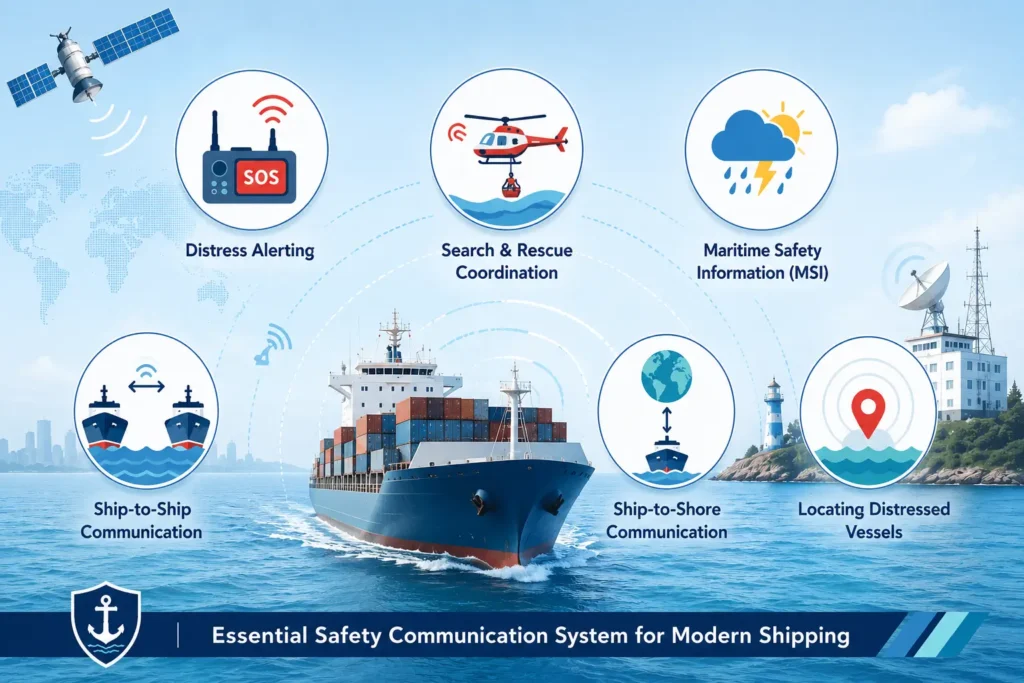
The system performs several vital functions to keep you safe during your voyages. Here are the core functions explained with practical examples.
- Distress alerting: This is the most crucial function. It allows a ship in danger to send a rapid digital alert to shore stations and nearby vessels. For example, if a fire breaks out in the engine room and gets out of control, pressing the dedicated distress button sends your exact position and identification number to rescue teams automatically.
- Search and Rescue coordination: Once an alert is received, land based centers use the system to coordinate the response. They can communicate with your ship, send out rescue helicopters, or instruct nearby commercial vessels to divert their course to assist you.
- Maritime Safety Information (MSI): This function keeps you informed about hazards. The system broadcasts navigational dangers, urgent weather warnings, and meteorological forecasts. For instance, if a tropical storm is developing along your route, you will receive an automated printout or display that will warn you ahead of time.
- Ship to ship communication: It allows your vessel to communicate directly with other ships nearby for standard navigation purposes or during a localized emergency, such as coordinating a passing maneuver in a congested channel to get immediate assistance from nearby vessels when at considerable distance off shore.
- Ship to shore communication: This allows you to manage daily public correspondence and operational messages between your ship and company managers or port authorities on land.
- Locating distressed vessels: Sending an alert is one thing, but rescue teams still need to find you in poor visibility or rough seas. The system uses specific transponders that show up on rescue radars and tracking screens, or EPIRB, for precise coordinates of distress, guiding the rescue boats directly to your survival craft.
GMDSS Sea Areas
The world’s oceans are divided into four distinct sea areas. The equipment your ship must carry is dictated by these areas.
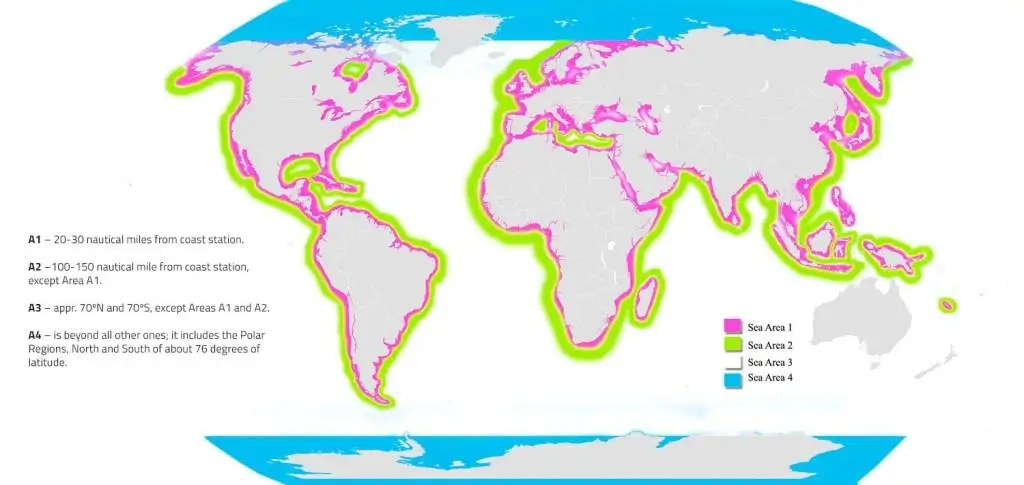
Sea Area A1
This is an area within the radiotelephone coverage of at least one coastal VHF station, in which continuous Digital Selective Calling alerting is available. This area typically extends about 20 to 30 nautical miles from the coast.
- Communication equipment required: Your ship must carry at least one VHF radio capable of Digital Selective Calling, a continuous watch receiver on channel 70, a NAVTEX receiver, and an emergency beacon.
| Sea Area A1 Equipment | Purpose |
| VHF Radio with DSC (Ch. 70 watch) | Distress and routine communications |
| NAVTEX Receiver | Maritime Safety Information (MSI) |
| 406 MHz EPIRB | Satellite distress alerting |
| Radar SART / AIS-SART | Search and rescue locating |
| Portable VHF Radios | Survival craft communications |
| GPS/GNSS Position Input | Automatic position reporting |
| Reserve Source of Energy | Emergency power for GMDSS equipment |
Sea Area A2
This area excludes Sea Area A1 and is within the radiotelephone coverage of at least one coastal MF station, providing continuous Digital Selective Calling alerting. This area usually extends up to about 100 to 150 nautical miles offshore.
- Communication equipment required: In addition to the Sea Area A1 equipment, ships must carry an MF radio system capable of Digital Selective Calling and a continuous watch on 2187.5 kHz.
Sea Area A3
This area covers the vast open oceans. The definition of this area changed recently to accommodate new technologies.
Prior to 1 January 2024, Sea Area A3 was defined as the area, excluding Sea Areas A1 and A2, within the coverage of Inmarsat geostationary satellites. This area covered most of the globe except for the extreme polar regions.
Following the SOLAS Chapter IV amendments that entered into force on 1 January 2024, Sea Area A3 is now defined as:
“An area, excluding Sea Areas A1 and A2, within the coverage of a Recognized Mobile Satellite Service (RMSS) supported by the ship earth station carried on board, in which continuous alerting is available.”
This amendment means that other satellite companies that receive international approval can now officially provide services in Sea Area A3 alongside traditional operators.
Sea Area A3 covers areas outside A1 and A2 that are within the coverage of an approved Recognized Mobile Satellite Service (RMSS). Since 1 January 2024, A3 is no longer limited to Inmarsat coverage; approved providers such as Iridium Communications can also provide GMDSS services. Ships must carry all A1 and A2 equipment, plus an approved satellite terminal or HF DSC radio.
- Communication equipment required: Ships must carry all equipment required for A1 and A2 areas, plus an approved satellite earth station or an HF radio communication system with Digital Selective Calling capabilities.
Sea Area A4
This area covers the remaining parts of the globe that are not included in Sea Areas A1, A2, and A3. In practical terms, these are the extreme polar zones above 76 degrees North and South latitude, where geostationary satellites do not have coverage.
- Communication equipment required: Because satellites have limited use here, your vessel must carry a full MF/HF radio system with Digital Selective Calling capabilities, alongside the standard VHF and emergency locating devices.
Recommended Read: EU ETS in Shipping: Meaning, Impact, Challenges & Future of Maritime Decarbonization
Major GMDSS Equipment on Board
Your ship’s bridge houses a variety of specialized units. Let us look at what each piece of equipment does.
VHF DSC Radio
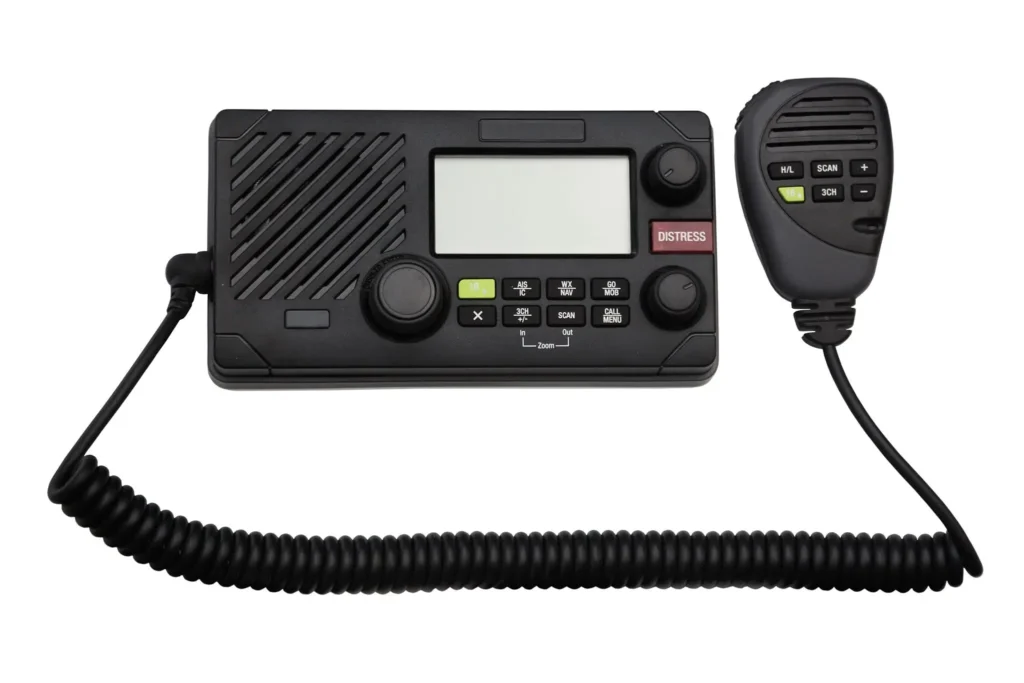
The Very High Frequency radio is your primary tool for short range communication. It operates on a line of sight principle, which means its effective range is generally limited to around 30 nautical miles depending on the height of your antenna. The Digital Selective Calling feature allows you to send an automated digital distress alert containing your unique ID number on channel 70.
MF/HF Radio
The Medium Frequency and High Frequency radio system is used for medium and long range communications. Medium frequency signals can reach up to 150 nautical miles, while high frequency signals can reflect off the upper atmosphere, allowing you to communicate across thousands of miles. This equipment uses digital calling on specific frequencies to alert shore stations when you are outside satellite coverage.
| Service | Frequency (kHz) |
| MF DSC Distress & Calling | 2187.5 |
| MF Radiotelephony Distress | 2182 |
| HF DSC Distress & Calling | 4207.5, 6312, 8414.5, 12577, 16804.5 |
| HF Radiotelephony Distress | 4125, 6215, 8291, 12290, 16420 |
Inmarsat System
This is a satellite network that provides continuous data and voice communication services. It allows you to send distress alerts, receive maritime safety information, and send emails or make phone calls to shore authorities. It plays a major role in keeping deep sea vessels connected to global networks.
EPIRB
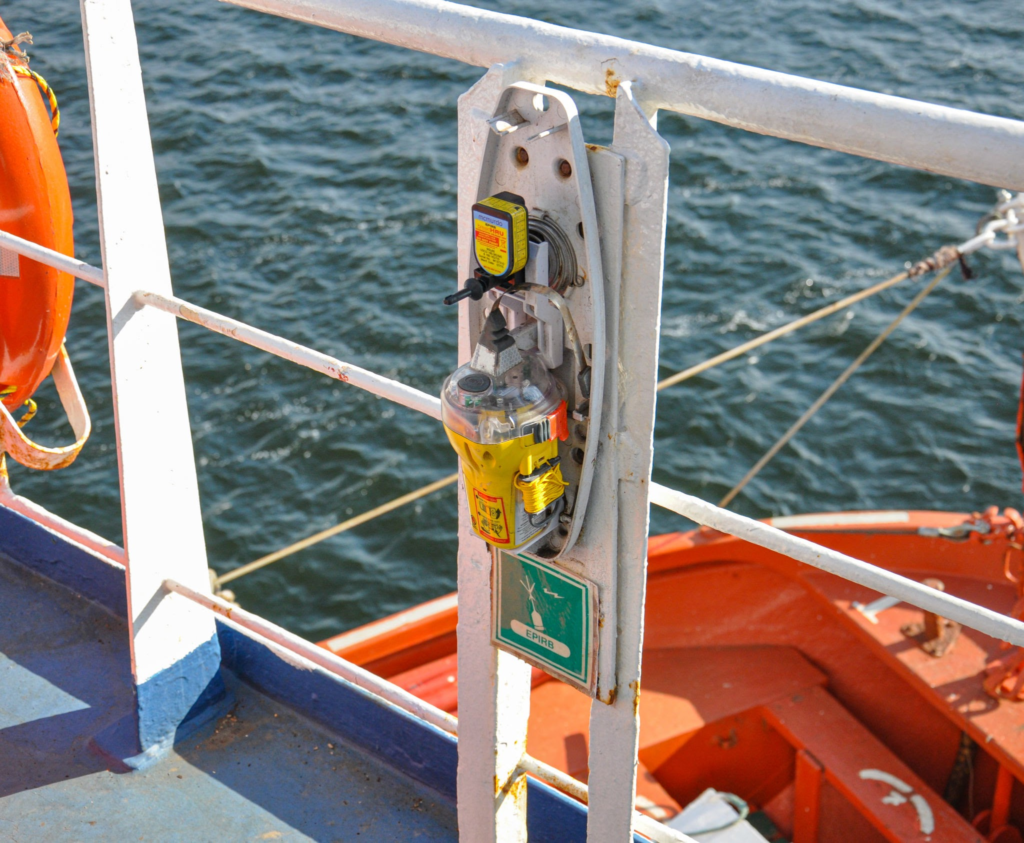
The Emergency Position Indicating Radio Beacon is a critical piece of life saving hardware. If your ship sinks, this device is designed to float free automatically from its bracket due to a Hydrostatic Release Unit (Commonly termed as HRU). Once it floats free or is manually turned on, it transmits a 406 MHz signal to search and rescue satellites. This signal contains your vessel identity and your exact position, allowing rescue teams to know exactly where the accident happened.
SART
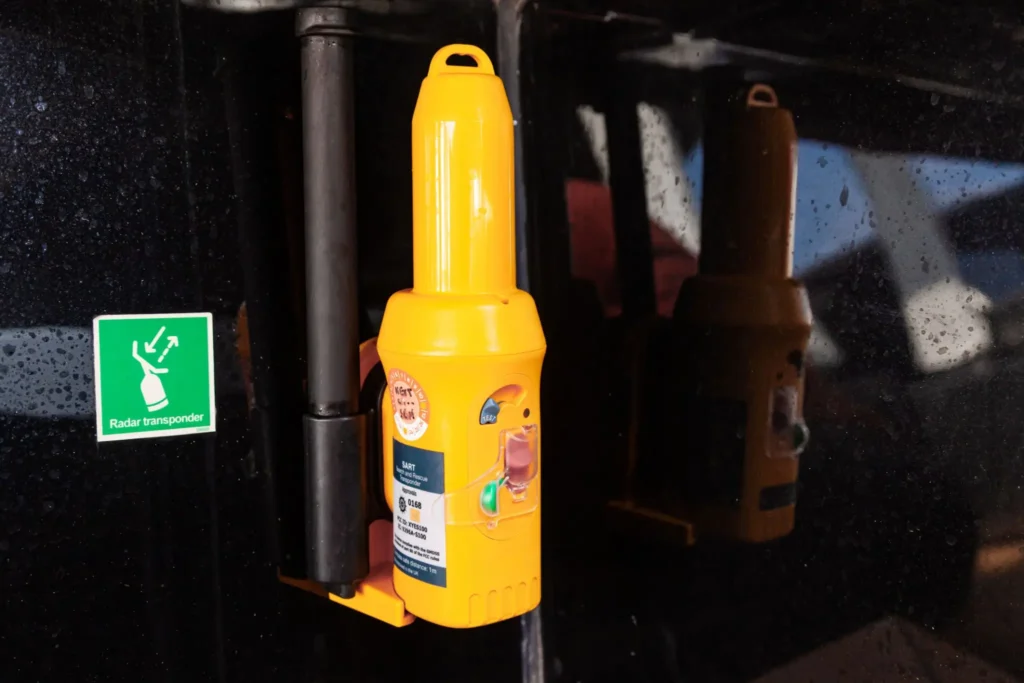
The Search and Rescue Transponder is a portable device that you must take with you when evacuating to a liferaft. When a searching ship or aircraft passes nearby, its radar sweeps activate your SART. The device then sends back a signal that appears on the rescue vessel’s radar screen as a line of twelve distinct dots, which subsequently turns into arcs and circles as range reduces, showing them exactly where your liferaft is floating.
NAVTE
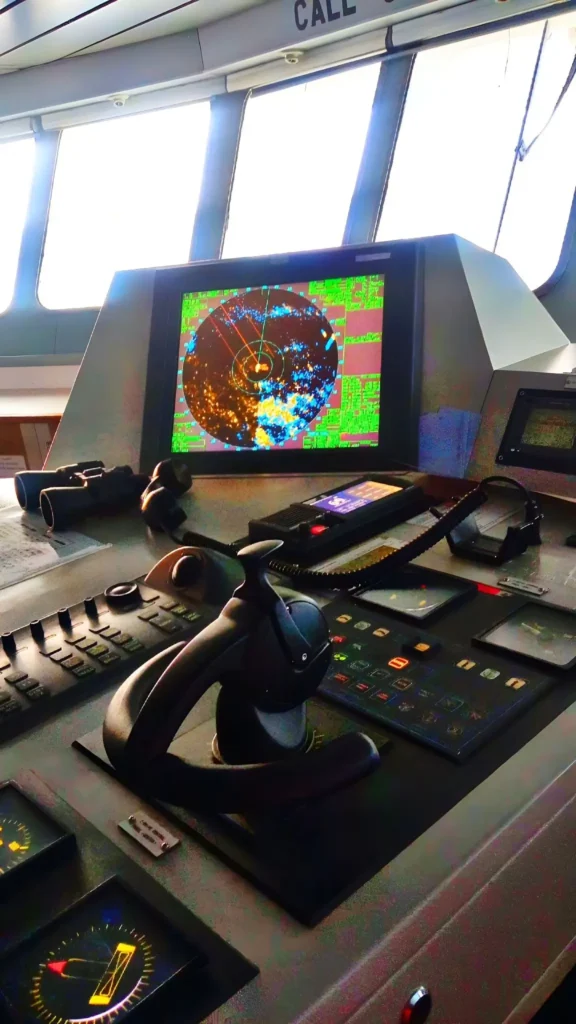
The Navigational Telex is an automated receiver that prints out or displays urgent safety information. It operates on specific frequencies, mainly 518 kHz for international transmission and 490 kHz for local transmission, and gives you text updates regarding navigation dangers, local weather forecasts, and search and rescue messages within 300 nautical miles of the coast.
AIS
The Automatic Identification System is a broadcast transceiver that works on the principle of Self organising time division multiple access (SOTDMA), which sends your ship’s speed, position, course, and identity to nearby vessels and shore stations. While it is heavily used for collision avoidance, it is also integrated into safety systems to help locate survival craft that carry portable AIS transponders.
Distress, Urgency and Safety Communications
Communications are prioritized to ensure that life threatening situations get absolute authority over the radio frequencies. You must understand the three primary signals.
Distress Signal (MAYDAY)
This signal has top priority over all other transmissions. You must only use it when your vessel, aircraft, or person is threatened by grave and imminent danger and requires immediate assistance.
- Real world example: Your vessel has sustained a major hull breach below the waterline after hitting an underwater object, and the ship is taking on water faster than the pumps can handle, forcing you to prepare for abandonment.
Urgency Signal (PAN-PAN)
This signal has priority over everything except distress messages. You use it when you have a very urgent message concerning the safety of a ship, aircraft, or person, but there is no immediate danger to life or the vessel itself.
- Real world example: A crew member has suffered a severe injury involving a deep laceration and major blood loss, and you need urgent medical advice from a doctor on shore, but the vessel itself is perfectly safe.
Safety Signal (SECURITE)
This signal indicates that the station is about to transmit an important navigational or meteorological warning.
- Real world example: You spot a large, semi submerged container floating in a busy shipping lane that could damage other vessels, and you want to warn all ships in the vicinity to keep a sharp lookout.
Recommended Read: What is Pump Priming and Why Is It Needed?
Digital Selective Calling (DSC)
Digital Selective Calling is a core technology within the modern radio network. It replaces the old practice of having a human operator listen to static heavy voice channels for hours.
What DSC is
It is essentially a digital paging system that lets you establish contact with another radio station before you start talking via voice. It sends a short digital burst over a dedicated channel that automatically triggers an alarm on the receiving radio.
How it works
Think of it like sending a text message before making a phone call. The digital message contains your unique nine digit Maritime Mobile Service Identity number, the purpose of your call, and the voice channel you want to use. Once the receiving station accepts the digital call, both radios automatically switch to the designated voice channel so you can speak.
Distress alert procedure
To send a DSC distress alert, lift the protective cover and press and hold the red DISTRESS button for the required time (typically 3–5 seconds, depending on the equipment model). This sends an undesignated distress alert, containing the vessel’s identity (MMSI) and position. If the nature of distress is known (such as fire, flooding, or collision), a designated distress alert can be sent by first selecting the distress category from the radio’s menu and then transmitting the alert.
After transmission, the radio automatically repeats the distress alert at regular intervals until a DSC acknowledgment is received from a coast station or rescue authority.
Benefits over voice communication
- It has a greater range than standard voice signals because digital data cuts through atmospheric interference much better.
- It ensures your distress alert is received even if the coastal station operator does not speak your language, as the data appears as standard text codes.
- It automates the process, meaning you do not have to spend precious time repeating your coordinates over the microphone when you need to focus on fighting an onboard emergency.
Maritime Safety Information (MSI)
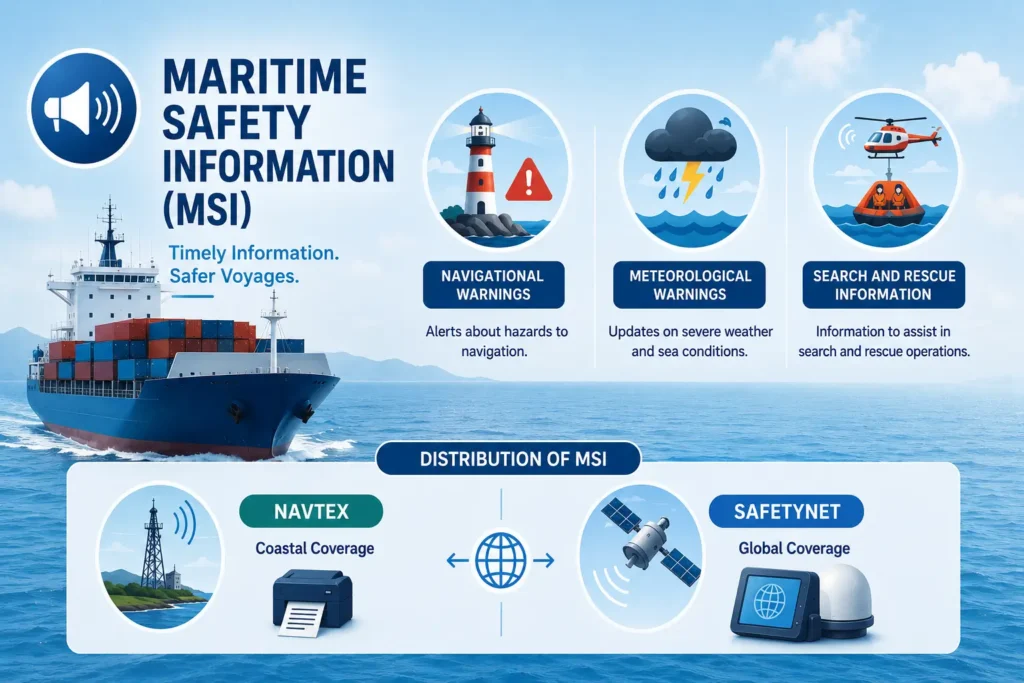
As a watchkeeper, you must always be aware of changing conditions around your vessel. The transmission of safety updates is a key pillar of ocean safety.
Navigational warnings
These warnings tell you about temporary or permanent hazards that could endanger your vessel. Examples include broken lighthouses, drifting military mines, newly discovered sandbanks, or ongoing search and rescue operations in the area.
Meteorological warnings
These give you critical updates about weather developments. They cover severe storm warnings, gale forces, heavy swells, and ice accumulation patterns that might require you to alter your route to protect your cargo and crew.
Search and Rescue information
If a nearby ship has gone missing or dropped a life raft, rescue centers use safety broadcasts to instruct all commercial ships in the sector to look out for survivors or participate in an active search pattern.
How NAVTEX and SafetyNET distribute MSI
- NAVTEX: NAVTEX is an automated receiver that provides coastal Maritime Safety Information (MSI), including navigational warnings, weather forecasts, and SAR messages. It continuously receives and displays messages automatically, eliminating the need to tune the radio for scheduled broadcasts. Operators can select specific stations and message types, but navigational, meteorological, and SAR messages cannot be disabled.
- SafetyNET: This is a satellite based service used when you are on the high seas outside the range of coastal stations. It sends identical safety updates directly to your satellite data terminal, ensuring your bridge crew has matching data anywhere on Earth.
GMDSS Operator Responsibilities
Carrying the equipment on board is useless if the units are not kept in perfect working order. As a qualified operator, you have strict maintenance duties to perform.
Daily checks
- You must verify that the paper or digital display on your printers and receivers is functional.
- You must check the operational status of your DSC facilities by verifying that the units are receiving position data from your GPS navigation systems.
- You must examine the state of your main radio battery banks by checking the voltage readings on your charging panels to ensure they are fully charged.
Weekly tests
- You must perform a live DSC test call to a coastal radio station if your vessel is within range of one.
- You must check your portable survival craft handheld two way VHF radios to ensure the batteries are fresh and the units transmit properly on channel 16.
Logbook entries
The radio logbook is a legal document. You must record:
- A summary of all communications relating to distress, urgency, and safety situations.
- The results of all equipment tests and details of battery maintenance.
- The exact times your ship enters different sea areas.
- Any equipment failures or false alerts that occurred during your watch.
Battery maintenance
Many units rely on emergency backup batteries. You must regularly check the electrolyte levels in lead acid batteries and clean any corrosion off the terminals. You must also monitor the expiration dates stamped on the sealed lithium batteries inside your EPIRBs and SARTs to ensure they are replaced before they expire.
Equipment readiness
You must ensure that all portable gear, like survival craft radios and transponders, are stored in their marked brackets near the bridge exit doors so they can be grabbed instantly during an emergency evacuation.
GMDSS Certification Requirements
To operate these systems on a commercial ship, you must hold a valid legal certificate that proves your competence.
GOC (General Operator Certificate)
This is the comprehensive qualification. It authorizes you to operate all types of equipment across all four sea areas. If you work on deep sea cargo ships or tankers that cross open oceans in Sea Area A3 and A4, you must hold this certificate.
ROC (Restricted Operator Certificate)
This is a limited qualification. It only covers short range equipment, primarily VHF systems. It is suitable for seafarers working exclusively within Sea Area A1, such as on coastal tugs, supply vessels, or local ferries that never venture far from land.
STCW requirements
The Standards of Training, Certification, and Watchkeeping convention mandates that deck officers must hold the appropriate radio operating qualification to keep a navigational watch. If you do not have a valid certificate matching your vessel’s operating area, your ship can be detained by port state control inspectors.
Who needs which certificate
- Deck Officers / Captains on international voyages: General Operator Certificate.
- Coastal Skippers / Port Tug Operators: Restricted Operator Certificate.
Recommended Read: What Are Rudders on Ships and Types of Ship Rudders
Common GMDSS Examination Questions
If you are preparing for your maritime certificate exams, you will face specific technical questions. Here are a few common examples with clear answers.
- What is the purpose of EPIRB? The purpose is to automatically or manually transmit an emergency signal containing your ship identification and location data to satellites, allowing rescue centers to pin down your position if your vessel sinks.
- Explain Sea Area A3. Following the 2024 updates, it is defined as the global ocean area outside of A1 and A2 that falls within the coverage of a recognised mobile satellite service carried on board your ship, providing continuous digital alerting.
- Difference between MAYDAY and PAN-PAN. A MAYDAY call is reserved exclusively for situations where there is grave and immediate danger to human life or the vessel itself. A PAN-PAN call is used when an urgent situation exists, but there is no immediate threat to life or the ship’s structural survival.
- What information is transmitted in a DSC distress alert? It transmits your unique Maritime Mobile Service Identity number, your last known GPS coordinates, the exact time the position was updated, and the nature of the distress if you had time to select it from the menu.
Common Mistakes Made by Seafarers
Even experienced mariners make critical errors when dealing with electronic communications. Avoiding these mistakes is vital for bridge safety.
Incorrect DSC testing
A major problem is seafarers sending out live distress test alerts to see if their equipment works. This triggers false alarms at rescue centers worldwide. You must only run internal loop tests or use the dedicated test menus that do not broadcast an actual emergency signal over the air.
Poor battery maintenance
Forgetting to log or check backup battery health can lead to total system failure if your main generators lose power during a shipboard fire or flooding event. Always treat your battery locker with the highest priority.
Wrong distress procedures
In an emergency, panic can cause watchkeepers to skip sending the digital DSC alert and jump straight to shouting over a voice microphone on channel 16. If you are too far from land, no one will hear your voice. Always hit your digital distress button first to guarantee your signal reaches land stations.
Missing logbook entries
Failing to record mandatory daily and weekly tests can result in major non conformities during safety audits. It also leaves your relief officer completely in the dark regarding the actual operational health of your bridge station.
Future of GMDSS
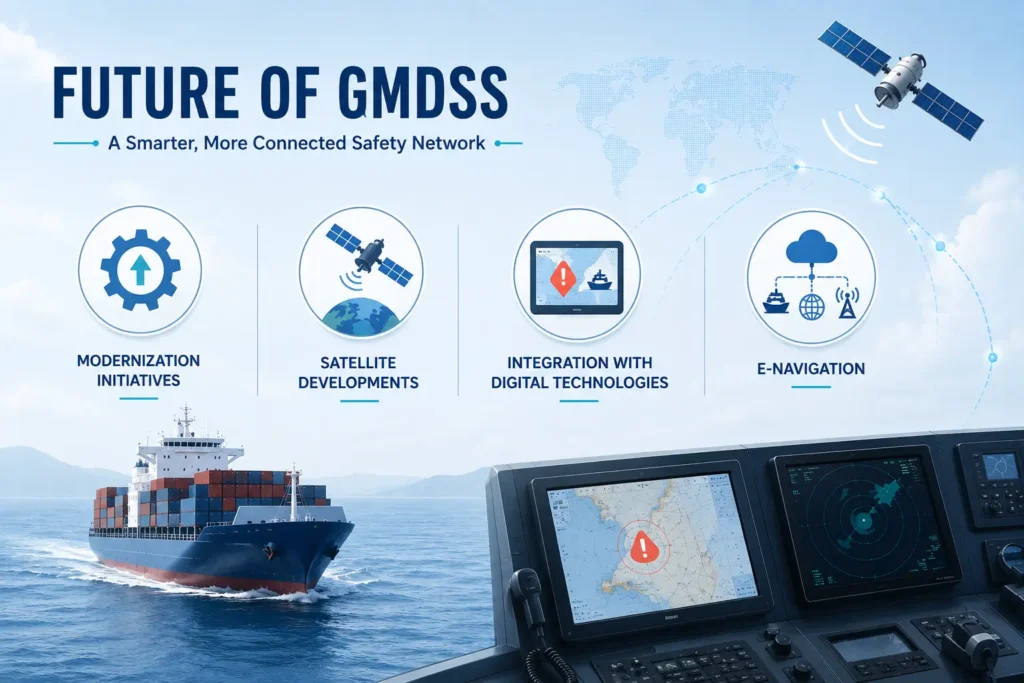
Maritime technology does not stand still. The global safety network is constantly undergoing updates to keep up with modern digital capabilities.
Modernization initiatives
The International Maritime Organization is continuously revising regulations to remove outdated systems and make room for faster data transmission tools. This includes improving text based messaging systems and standardizing user interfaces across different equipment manufacturers.
Satellite developments
The monopoly of single satellite operators is gone. With the 2024 SOLAS updates, multiple low Earth orbit and geostationary satellite systems are being integrated into the safety network. This brings better coverage to northern routes and creates healthy competition, leading to more reliable hardware.
Integration with digital technologies
Modern radios are becoming fully integrated with electronic chart display systems. This means that if a nearby vessel sends out a distress call, their location can pop up instantly as a flashing icon on your electronic chart screen, allowing you to plot a rescue course immediately.
E-navigation
The future lies in seamless digital data sharing. E navigation concepts aim to link all navigation sensors, weather feeds, and communication systems into a single streamlined network, reducing the administrative workload on your bridge and allowing you to focus on safe watchkeeping.
Conclusion
Summary of key points
The Global Maritime Distress and Safety System changed ocean safety by moving away from old manual monitoring methods to an automated, digital, and satellite driven framework. By understanding your sea areas, maintaining your onboard equipment, and knowing the difference between critical distress signals, you ensure your vessel remains connected to global rescue centers.
Importance of maintaining GMDSS proficiency
Technology is only as good as the person operating it. You must stay updated on changing regulations, such as the recent shift in how Sea Area A3 is defined, and practice your emergency routines regularly until they become second nature.
Final safety message
When the lines are cast off and you head out into open water, your radio panel is your ultimate lifesaver. Take care of your equipment, perform your mandatory tests diligently, and always respect the power of the distress button. Your commitment to communication safety is what ensures you and your crew return home safely at the end of every voyage.
Recommended Read: US C1/D Visa Interview Questions and Tips: A Detailed Guide
Frequently Asked Questions
1. What is the main purpose of the GMDSS?
Its main purpose is to make sure any ship can send an instant, automated distress alert to rescue teams and other vessels from anywhere in the world during an emergency.
2. How do the 2024 changes affect Sea Area A3?
The updated rule allows multiple approved satellite companies to provide emergency communication services in this area instead of relying on just one network.
3. What is the difference between a MAYDAY and a PAN-PAN call?
You use a MAYDAY call only when there is an immediate danger to human life or the ship itself. A PAN-PAN call is used for very urgent situations that are not life-threatening.
4. How does an EPIRB help rescue teams find a sinking ship?
An EPIRB floats to the top automatically if a ship sinks and sends a digital signal to satellites showing your exact location.
5. Why is Digital Selective Calling better than traditional voice radio?
Digital calling can travel much farther through bad weather and automatically triggers an alarm on other ships without you having to speak immediately.