
Have you ever stood on the deck of a ferry or watched a massive cargo ship glide through the water and wondered how something so enormous changes direction? It is not like a car where the wheels turn on a road. In the ocean, the force of the water is constant and powerful. To master this environment, ships rely on a critical component called the rudder.
In this guide, you will learn everything you need to know about rudders. We will talk about how they work, the physics behind their movement, and the many different types used in the maritime industry today.
Whether you are a student looking at a career at sea or just curious about engineering, this breakdown will give you a clear picture of ship steering systems.
Table of Contents
What is a Ship Rudder?
At its simplest level, a rudder is a flat or shaped blade located at the back of a ship. It is usually placed right behind the propeller. Its primary job is to create a turning force that allows the navigating officers to control the heading of the vessel.
Without a rudder, a ship would just drift with the wind and the currents. While some modern boats use water jets or podded engines that rotate, the vast majority of ships in the world still use the traditional rudder system because it is reliable and effective.
How Does a Rudder Work?
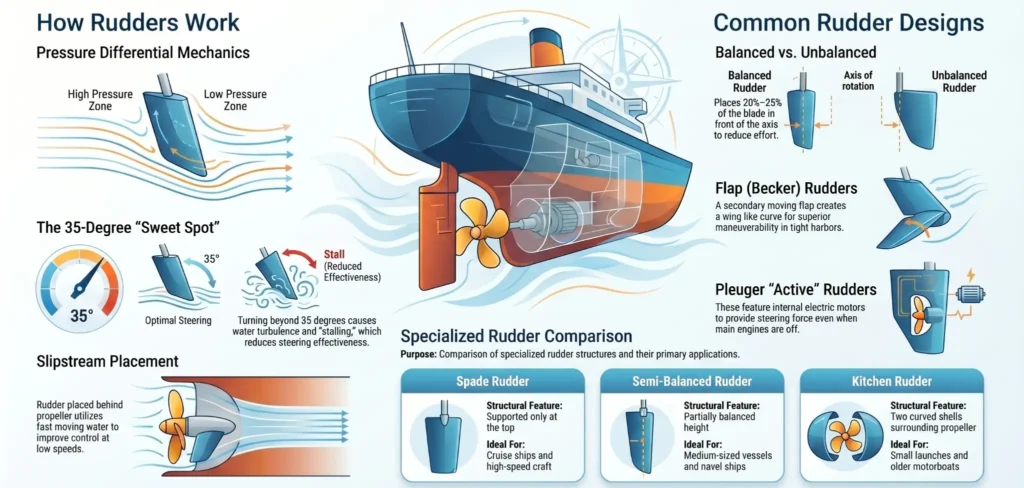
A rudder controls the ship’s direction by using the flow of water acting on its surface. This water flow is created mainly by the ship’s forward motion and, in many cases, is increased by the propeller wash passing over the rudder. When the rudder is kept amidships (straight), water flows evenly over both sides, producing little sideways force, so the ship continues on its present heading.
When the helm is applied, the steering gear turns the rudder to a selected angle. The rudder then deflects the water flow, creating higher pressure on one side of the rudder and lower pressure on the other. This pressure difference generates a lateral force on the rudder blade. Since the rudder is fitted at the stern, this force pushes the ship’s aft section sideways, causing the vessel to rotate about its pivot point. As a result, the bow swings in the opposite direction and the ship changes course.
At low speeds, rudder effectiveness depends greatly on propeller wash over the rudder, which is why steering response is stronger when propulsion is applied. At higher speeds, the ship’s own movement through the water provides sufficient flow for effective steering.
The Components of a Rudder System
A rudder is not just a single piece of metal hanging off the back of a boat. It is part of a complex system. Here are the main parts you should know about:
- The Rudder Blade: This is the main part that actually moves through the water. It is usually made of thick steel plates.
- The Rudder Stock: This is a heavy metal shaft that connects the rudder blade to the steering gear inside the ship. It transmits the turning force.
- Pintles: These are large pins that act as hinges. They allow the rudder to swing back and forth.
- Gudgeons: These are the brackets attached to the ship’s stern post that hold the pintles in place.
- The Steering Gear: This is the machinery located inside the steering gear room. it uses hydraulic or electric power to turn the rudder stock.
- The Rudder Trunk: This is a watertight casing that the rudder stock passes through as it goes from the inside of the ship to the outside water.
Different Types of Rudders on Ships
Not every ship uses the same kind of rudder. The design depends on the size of the vessel, the speed it travels, and how much maneuverability it needs. Here are the most common types you will encounter in the maritime world.
1. Unbalanced Rudders
This is the most basic design. In an unbalanced rudder, the entire area of the rudder blade is behind the axis of rotation. This means the rudder stock is attached at the very front edge of the blade.
- How it feels: Because the entire blade is catching the water behind the pivot point, it takes a lot of force to turn the rudder.
- Usage: You will mostly see these on smaller boats or very old ships.
- Pros: They are simple to build and maintain.
- Cons: They require very powerful steering gear because the water pressure is always fighting against the turn.
2. Balanced Rudders
A balanced rudder is designed to make the job of the steering gear easier. In this design, a portion of the rudder blade is placed in front of the axis of rotation. Usually, about 20 percent to 25 percent of the area is in front of the rudder stock.
- How it feels: As the rudder turns, the water hitting the front part helps pull the rudder into the turn. This balances out the force of the water hitting the back part.
- Usage: Most modern commercial ships use balanced rudders.
- Pros: It requires much less power to turn the rudder, which saves energy and reduces wear on the machinery.
- Cons: The design is slightly more complex than an unbalanced rudder.
3. Semi Balanced Rudders
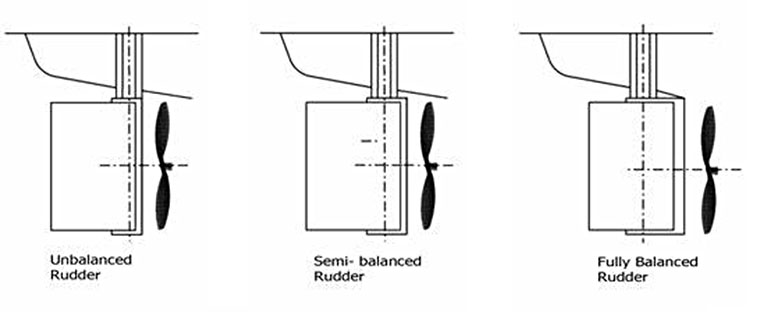
As the name suggests, this is a mix of the two previous types. In a semi balanced rudder, only a part of the rudder height is balanced. The top part might be unbalanced, while the bottom part has a portion in front of the stock.
- How it works: These are often used on twin screw ships. They provide a good balance between steering power and structural strength.
- Usage: Common on medium sized vessels and some naval ships.
4. Spade Rudders
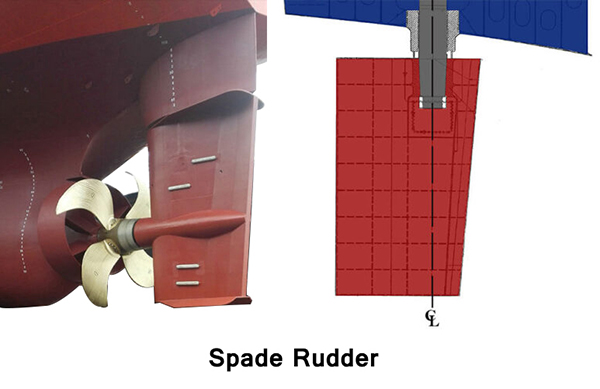
A spade rudder is unique because it is not attached to the ship’s hull at the bottom. It is only supported by the rudder stock at the top. This means the rudder hangs freely beneath the ship.
- Design: These are almost always fully balanced.
- Usage: You will see these on many modern cruise ships, passenger ferries, and high speed craft.
- Pros: They are very efficient and offer great maneuverability because they can be turned to large angles without being blocked by a stern post.
- Cons: The rudder stock has to be incredibly strong because it has to support the entire weight and force of the rudder without any bottom support.
5. Flap Rudders (Becker Rudders)
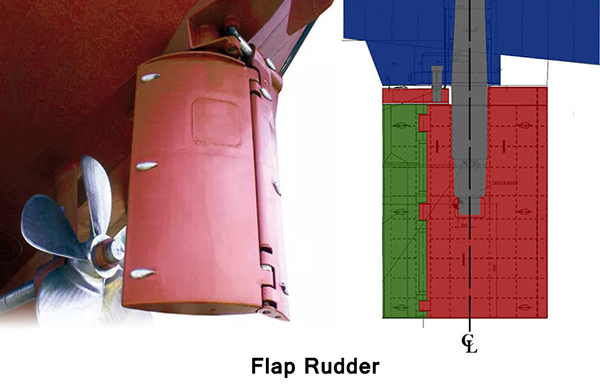
The flap rudder is a high tech version of a standard rudder. It looks like a normal rudder, but it has a smaller secondary flap attached to the back edge. This flap is connected by a mechanical link so that when the main rudder turns, the flap turns even further.
- The Effect: This creates a curved shape similar to an airplane wing. It generates much more lift and turning force than a flat blade.
- Usage: Ships that need to operate in tight harbors or rivers, like tugboats or large container ships, often use these.
- Pros: Excellent maneuverability even at low speeds.
- Cons: They have more moving parts, which means more maintenance is needed.
6. Pleuger Rudders (Active Rudders)
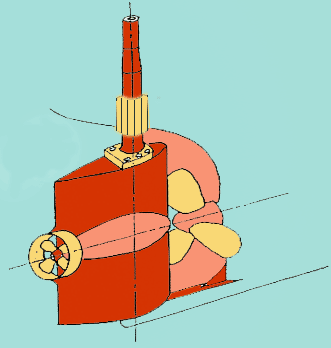
This is a very specialized type of rudder. A Pleuger rudder has a small electric motor and a propeller mounted directly inside the rudder blade.
- The Benefit: On a normal ship, if the ship is not moving, the rudder does nothing because there is no water flowing over it. With an active rudder, you can turn the rudder and turn on the small propeller to push the back of the ship sideways, even if the main engines are off.
- Usage: Used on ships that need extremely precise positioning, like research vessels or cable layers.
7. Kitchen Rudders
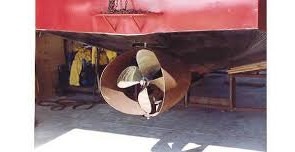
The Kitchen rudder is a very old but clever design used on small boats. Instead of a single blade, it uses two curved shells that surround the propeller.
- How it works: By changing the position of these shells, you can direct the propeller thrust to the side, or even close them behind the propeller to force the water forward, making the boat go in reverse without changing the engine direction.
- Usage: Mostly found on small launches or older motorboats.
Recommended Read: 15 Biggest LPG Carriers Powering Global Gas Trade
The Science of Ship Rudder Performance
When engineers design a rudder, they have to consider several factors to make sure the ship stays safe and easy to handle. If you are interested in maritime studies, these are the concepts you will study in detail.
1. The Aspect Ratio
The aspect ratio is the relationship between the height of the rudder and its width. A tall, skinny rudder has a high aspect ratio. A short, wide rudder has a low aspect ratio.
- High Aspect Ratio: These are more efficient at creating lift and are used on faster ships.
- Low Aspect Ratio: These are more durable and are often used on ships that operate in shallow water where a deep rudder might hit the bottom.
2. The Rudder Angle
Most ships have a maximum rudder angle of about 35 degrees. You might wonder why they don’t turn it to 90 degrees to make a sharp turn. The reason is a phenomenon called “stalling.”
Just like an airplane wing, if the angle is too steep, the water can no longer flow smoothly over the surface. Instead, it becomes turbulent and the turning force actually drops. For most ships, 35 degrees is the sweet spot where you get the most turning force without losing control of the water flow.
3. Cavitation
When a rudder moves through the water at high speeds, the pressure on the low pressure side can drop so low that the water actually boils and turns into small vapor bubbles. This is called cavitation.
When these bubbles collapse against the surface of the metal, they cause tiny explosions that can chip away at the steel over time. Engineers have to design the shape of the rudder carefully to prevent this from happening, as it can destroy a rudder in a matter of months.
How Rudders on Ships Are Maintained
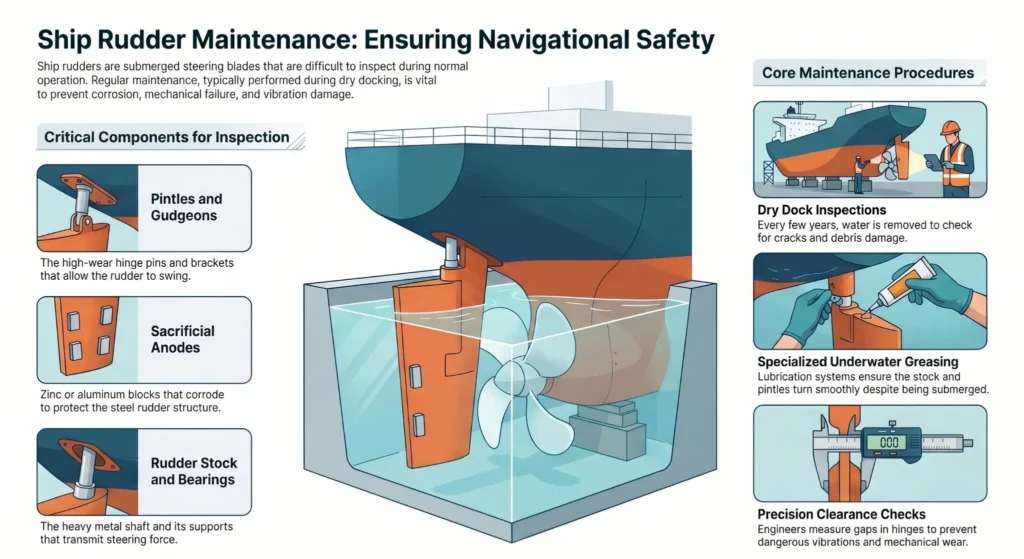
Since rudders are underwater, they are difficult to inspect while the ship is working. However, they are vital for safety, so they require regular care.
- Dry Docking: Every few years, a ship must go into a dry dock where the water is pumped out. This is when engineers inspect the rudder for cracks, corrosion, or damage from hitting debris.
- Anodes: You will often see small blocks of zinc or aluminum attached to the rudder. These are called sacrificial anodes. They corrode instead of the steel rudder, protecting the main structure from the salty sea water.
- Greasing: The pintles and the rudder stock bearings need to be kept lubricated. Even though they are underwater, they have special grease systems to make sure they turn smoothly.
- Clearance Checks: Engineers measure the gap between the pintles and the gudgeons. If the gap is too big, the rudder will vibrate and cause damage to the ship.
The Future of Ship Steering
As technology moves forward, the way we steer ships is changing. While the rudder is still the king of the ocean, new systems are appearing.
Azimuth Thrusters
Some ships no longer have a traditional rudder or a fixed propeller. Instead, they use an azimuth thruster. This is a propeller inside a pod that can rotate 360 degrees. Since the propeller can point in any direction, the ship does not need a rudder at all. These are very common on modern cruise ships and offshore support vessels.
Automated Steering
In the past, a helmsman had to hold the wheel at all times. Today, most ships use an autopilot system connected to GPS. You can program a course into the autopilot (Computer heading controller), and the computer will make tiny adjustments to the rudder to keep the ship exactly on track. This is much more accurate than a human and helps save fuel by keeping the ship in a perfectly straight line.
Recommended Read: Bulk Carriers: The Backbone of Global Commodity Transport
In a Nutshell
If you are thinking about a career as a marine engineer or a deck officer, understanding rudders is a great first step. Here is a quick recap of what you should remember:
- Primary Function: The rudder converts the energy of moving water into a sideways force that turns the ship.
- Location: Almost always at the back, behind the propeller to take advantage of the fast moving water.
- Balance: Balanced rudders use some of the water pressure to help the steering gear turn the blade.
- Maneuverability: Specialized rudders like flap rudders or Pleuger rudders allow ships to move in very tight spaces.
- Maintenance: Rudders must be checked in dry dock to prevent corrosion and mechanical failure.
Ships are some of the most impressive machines ever built by humans. Even though they are now filled with computers and satellite technology, they still rely on the simple, physical principle of a rudder moving through the water. It is a perfect example of how basic physics is used to solve massive engineering challenges.
The next time you see a ship, look at the stern. You might not be able to see the rudder beneath the waves, but you now know exactly what is happening down there to keep that ship on the right path. Stay curious and keep exploring the world of maritime engineering!
Frequently Asked Questions
1. What is the primary purpose of a rudder on a ship?
The primary purpose of a rudder is to provide directional control by redirecting water flow to create a turning force. This allows the vessel to change its heading or maintain a steady course against wind and currents.
2. Why are most rudders placed directly behind the ship propeller?
Rudders are placed behind the propeller because the propeller accelerates the water, creating a high velocity stream called a slipstream. This faster moving water hits the rudder surface with more force, making the steering much more effective even at low ship speeds.
3. What is the difference between a balanced and an unbalanced rudder?
An unbalanced rudder has its entire surface area behind the turning axis, requiring more power to move. A balanced rudder has a portion of its area in front of the axis, which uses the water pressure to help the steering gear turn the blade more easily.
4. Can a ship still steer if the engines are turned off?
A ship can still steer as long as it has “way” or forward motion, because water is still flowing past the rudder. However, if the ship stops moving entirely, a standard rudder becomes useless because there is no water flow to create a turning force.
5. What is the maximum angle a rudder can usually turn?
Most ship rudders have a maximum angle of about 35 degrees on either side. Beyond this angle, the water flow becomes turbulent and the rudder “stalls,” which causes a loss of steering effectiveness and increases drag significantly.