
If you have ever spent time around heavy machinery, worked on a farm, or looked into a career in the Merchant Navy, you have likely heard the phrase “prime the pump.” In common English, we use this phrase to mean “getting something started,” but in the world of engineering, it is a literal, physical necessity.
Without proper priming, a pump is little more than a noisy, spinning piece of metal. If ignored, a lack of priming can lead to catastrophic mechanical failure, melted seals, and thousands of dollars in repair costs.
This guide will dive deep into the science of pump priming, the different methods used in modern industry, and how to troubleshoot common issues like a professional engineer.
Table of Contents
1. Understanding the Anatomy: Why Pumps Struggle with Air
To understand pump priming, we must first look at the Centrifugal Pump, which is the workhorse of almost every industry. These pumps are designed to move liquids – water, oil, chemicals, or fuel by using centrifugal force.
How a Centrifugal Pump Works
Inside the pump is a component called the impeller, which looks like a high-powered fan. As the motor spins the impeller, it creates a “centrifugal” force that flings the liquid outward toward the edges of the pump casing.
This outward movement of liquid creates a low-pressure zone at the center (the eye) of the impeller. In a perfect system, the atmospheric pressure pushing down on the water source (like a tank or a well) forces the water up the suction pipe to fill that low-pressure zone.
The “Air” Problem
The fundamental physics of a centrifugal pump rely on the density of the fluid. Water is roughly 800 times denser than air. Because air is so light and “squishy” (compressible), the spinning impeller cannot generate enough force to fling it away and create a vacuum strong enough to lift water from a lower level.
If the pump casing is full of air, the impeller just spins the air around in circles. This state is known as Air Binding. Until that air is replaced by a heavy liquid, the pump will never be able to “grab” the water and start the flow.
2. The Definition and Core Purpose of Pump Priming
Pump Priming is the process of completely removing air or gas from the pump casing and the suction line by filling them with the liquid intended to be pumped.
Why can’t we just wait for the pump to clear the air?
It is a common misconception that if you let a pump run long enough, it will eventually suck up the water. In reality, running a pump “dry” is one of the fastest ways to destroy it. Here is why pump priming is a non-negotiable step:
- Mechanical Seal Protection: Most pumps use mechanical seals to prevent water from leaking out where the motor shaft enters the pump. These seals rely on the liquid being pumped to stay cool and lubricated. Running dry creates intense friction heat, which can crack or melt the seals in under two minutes.
- Preventing Cavitation: If air bubbles are trapped during startup, they can cause “cavitation,” a phenomenon where vapor bubbles collapse violently against the impeller, pitting the metal and causing vibration.
- System Efficiency: A primed pump operates at its designed pressure and flow rate immediately, reducing energy waste.
3. Key Terminology for Engineering Students
Before we explore methods, let’s define the parts of the system you’ll be working with:
| Term | Technical Role | Simple Translation |
| Casing | The airtight chamber surrounding the impeller. | The “body” of the pump. |
| Suction Lift | The vertical distance the pump must pull water upward. | The height of the “climb.” |
| Foot Valve | A check valve at the bottom of the suction pipe. | A one-way “trap door.” |
| Venting | The act of releasing air through a specific valve. | Letting the pump “burp.” |
| Static Head | The total vertical height the pump moves liquid. | The total “push” required. |
4. Advanced Methods of Pump Priming
Depending on whether you are working on a small domestic garden pump or a massive ballast pump on a cargo ship, the method of priming will change significantly.
A. Pump Priming with a Foot Valve
A foot valve is installed at the very bottom of the suction pipe. It allows water to flow into the pipe but closes tight if the water tries to flow back down into the source.
- The Advantage: Once you prime the pump for the very first time, the foot valve keeps the suction pipe full of water indefinitely. As long as the valve doesn’t leak, the pump is “self-primed” for every future start.
- Risk: If a small pebble or piece of seaweed gets stuck in the valve, the water will drain out, and you will have to re-prime.
B. Vacuum Pump Priming (Industrial Standard)
In large-scale operations, like municipal water plants or marine engine rooms, manual priming isn’t possible. Instead, a secondary, smaller “Vacuum Pump” is connected to the main pump’s casing.
- Process: The vacuum pump is turned on first. It sucks all the air out of the main system. As the pressure drops, the water from the source naturally rises up the pipe.
- Visual Check: Engineers often use a “sight glass,” a small window in the pipe, to see when the water has arrived before turning on the main pump.
C. Self-Priming Centrifugal Pumps
Some pumps are designed with an extra-large casing that acts as a water reservoir.
- How it works: You fill the casing once. When the pump starts, it circulates the water inside, mixing it with the air in the suction pipe. This “air-water mixture” is pushed out, the air is vented, and the water returns to the reservoir. Eventually, all the air is evacuated, and the pump begins normal operation.
- Note: These are highly popular in construction and drainage because they can handle “re-priming” themselves if air enters the line during operation.
5. Step-by-Step Guide: How to Prime a Pump Properly
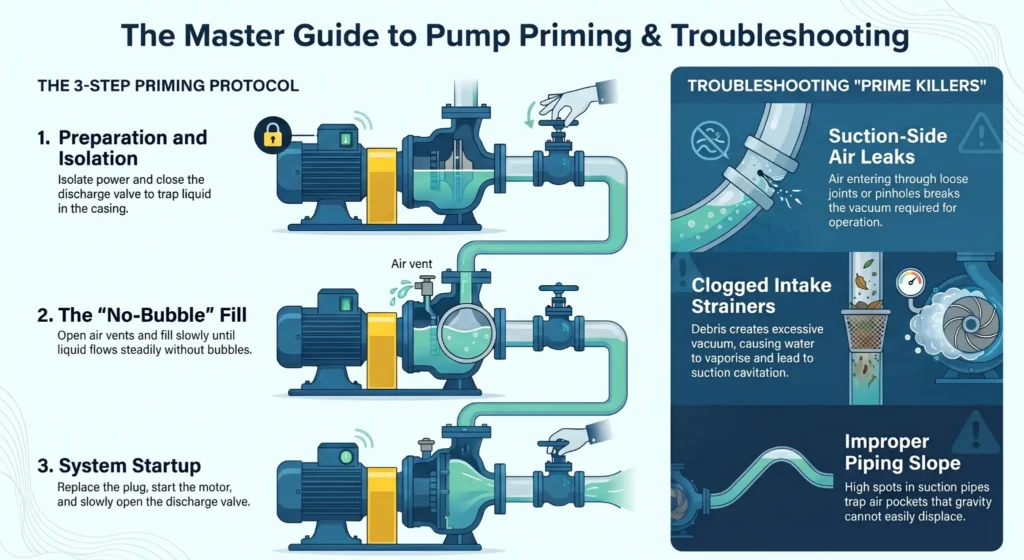
If you are tasked with priming a manual system, follow this professional protocol to ensure safety and equipment longevity:
- Isolate the Power: Ensure the motor is off and “Locked Out/Tagged Out” if necessary. Never attempt to prime while the impeller is spinning.
- Close the Discharge: Close the valve on the outlet side. This helps trap the priming liquid within the casing.
- Open the Air Vents: Locate the air cock or priming plug on the top of the casing. Open it to allow air to escape as liquid enters.
- Fill the System: Pour the liquid in slowly. If you are using a hose, ensure the flow isn’t so fast that it traps air pockets.
- The “No-Bubble” Rule: Continue filling until liquid flows out of the vent steadily without any bubbles or “hissing” sounds.
- Seal and Check: Replace the priming plug. Gently turn the pump shaft by hand (if safe) to dislodge any bubbles trapped in the impeller vanes.
- Startup: Turn on the motor. Once you hear the pump “bite” (the sound changes from a high-pitched whirr to a deeper hum), slowly open the discharge valve.
Recommended Read: What Are Rudders on Ships and Types of Ship Rudders
6. Troubleshooting: When the Prime Fails
Sometimes, you can pour water into a pump for an hour and it still won’t start. Here is a checklist of common “Prime Killers”:
1. The Suction Leak (The “Ghost” in the Pipe)
This is the most common issue. Because the suction pipe is under negative pressure, it won’t leak water out, but it will suck air in. Even a pinhole leak in a joint or a loose bolt on a flange will allow enough air into the system to break the vacuum.
- Tip: Use soapy water on the joints; if you see bubbles being sucked inward, you’ve found your leak.
2. Clogged Suction Strainer
If the pump is trying to pull from a river or a dirty tank, the strainer (the “filter” at the end of the pipe) can become clogged with trash. If the pump can’t get enough water, it will create a vacuum so high that the water actually turns into vapor, causing “Suction Cavitation.”
3. Air Pockets in the Piping
If the suction pipe has a “hump” or a high spot before it reaches the pump, air will get trapped in that hump. Gravity won’t let the water push the air down and over the hump easily.
- Best Practice: Suction piping should always slope upward toward the pump to ensure air moves naturally toward the vent.
7. Safety Precautions for Engineers and Operators
- Temperature Checks: If a pump has been running dry, the casing will be extremely hot. Do not suddenly pour cold water into a hot pump casing, the thermal shock can shatter the metal (especially cast iron). Let it cool naturally first.
- Chemical Safety: If you are priming a pump for chemicals or acids, ensure you are wearing full PPE (Personal Protective Equipment). A “splash back” from a priming port can be dangerous.
- Electrical Hazards: Always ensure your priming water doesn’t spill onto the motor or electrical junction boxes.
8. The Critical Importance of Pump Priming in the Merchant Navy
For those looking toward a career at sea, pump priming is a matter of safety. Ships rely on pumps for:
- Bilge Pumping: Removing water from the bottom of the ship to prevent sinking.
- Firefighting: Providing high-pressure water to fire monitors.
- Engine Cooling: Keeping the massive main engines from melting.
In an emergency, such as a fire or a flood, there is no time to troubleshoot a pump. This is why marine engineers perform regular “Priming Trials” to ensure that the vacuum pumps and foot valves are in perfect working order. A “dry” fire pump during an emergency is a disaster that no sailor wants to face.
Recommended Read: US C1/D Visa Interview Questions and Tips: A Detailed Guide
Summary and Key Takeaways
Pump Priming isn’t just a “suggestion”; it is a mechanical requirement for the majority of the world’s pumps.
- Air is the Enemy: Centrifugal pumps cannot move air effectively because it lacks the density to create a vacuum.
- Protection: Pump priming protects the expensive mechanical seals and the impeller from heat and cavitation.
- Methods: Whatever method you use, the goal is the same: Get the air out.
- Maintenance: Always check your suction pipes for air leaks, as even the best priming job can be ruined by a loose bolt.
By mastering the art of pump priming, you ensure that your machinery runs longer, stays cooler, and works exactly when you need it to. Whether you are in a factory, on a farm, or 500 miles out at sea, a well-primed pump is the sign of a true professional.
Frequently Asked Questions (FAQ)
1. Can a pump ever prime itself?
Only if it is specifically a “Self-Priming” model or if the water source is located above the pump (known as a flooded suction), where gravity naturally keeps the pump full.
2. How long can I run a pump dry while waiting for it to prime?
Ideally, zero seconds. Most manufacturers suggest that if a pump hasn’t “caught” its prime within 60 to 90 seconds, it should be shut down to prevent seal damage.
3. What is the difference between pump priming and venting?
Pump priming is the act of filling the system with liquid; venting is the act of releasing the air that the liquid is replacing. They usually happen at the same time.
4. Why does my pump lose its prime after it’s been sitting overnight?
This usually indicates a leaky foot valve. The water has slowly drained back into the source, allowing air to take its place.