
If you have ever looked out at the ocean and wondered how the products you buy everyday arrive at your local store, the answer lies with seafarers. The global maritime shipping sector is the backbone of international trade, and the people who work on these ships make everything possible.
Every five years, two major international organizations, BIMCO and the International Chamber of Shipping, publish a comprehensive study called the Global Seafarer Workforce Report. The latest edition has been released for the year 2026, and it contains critical information about the current state of the global shipping workforce, where the industry is growing, and what challenges lie ahead.
Whether you are a ship owner, a maritime student, a policymaker, or simply someone interested in how the world economy moves, this report offers vital insights. This blog post will walk you through the key findings of the report, breaking down the numbers and what they mean for the future of global shipping.
Table of Contents
Understanding the Purpose and Value of the Report
Before diving into the numbers, it is helpful to understand why this report is so important. The Seafarer Workforce Report 2026 provides a detailed overview of the balance between the supply and demand of qualified seafarers who hold certifications under the International Convention on Standards of Training, Certification and Watchkeeping for Seafarers. These are commonly known as STCW certified seafarers.
The report focuses on three primary areas:
- The total balance between the supply of qualified seafarers available to work on international merchant ships and the actual demand from shipping companies to operate those ships.
- The detailed composition of the workforce, which includes information regarding nationalities, specific ranks or roles, age profiles, and gender diversity.
- The predicted growth of the world merchant fleet over the next five years and how that growth will impact the balance of labor.
To gather this information, the researchers used a reliable methodology that matches past reports while adding new improvements. They collected information from maritime administrations, shipping companies, educational institutions, and industry experts. They also used data from open registries and the European Maritime Safety Agency STCW Information System to make sure the findings are as accurate as possible. Several major academic and maritime institutions, including the Indian Maritime University and Dalian Maritime University, helped validate the methods used, ensuring the data is dependable.
The Global Supply of Seafarers: A Growing Workforce
When you look at the total number of qualified seafarers available to work globally in 2026, the numbers are larger than ever before. The report estimates that the total global supply of seafarers now stands at 2,565,580 individuals.
The workforce is divided into two main categories: officers and ratings. Officers are the managers and specialized leaders on a ship, such as captains and engineers. Ratings are the skilled workers who handle daily operations, maintenance, and deck work.
The supply breakdown for 2026 looks like this:
- Total Officers: 1,048,980
- Total Ratings: 1,516,600
When you compare these numbers to the previous report published in 2021, you can see a clear upward trend. The number of qualified officers has grown by about 22 percent since 2021.
At the same time, the number of ratings has grown even faster, showing an increase of 47 percent over the same period. This means that more people are entering the maritime profession and obtaining their official certifications than we saw five years ago.
Top Countries Supplying the Maritime Workforce
The shipping industry is truly international, with crew members coming from every part of the globe to work together. However, a large percentage of the workforce comes from just a few key countries. The 2026 report shows that five nations supply more than half of the entire global seafarer workforce. Together, these five countries represent 56.25 percent of the total supply.
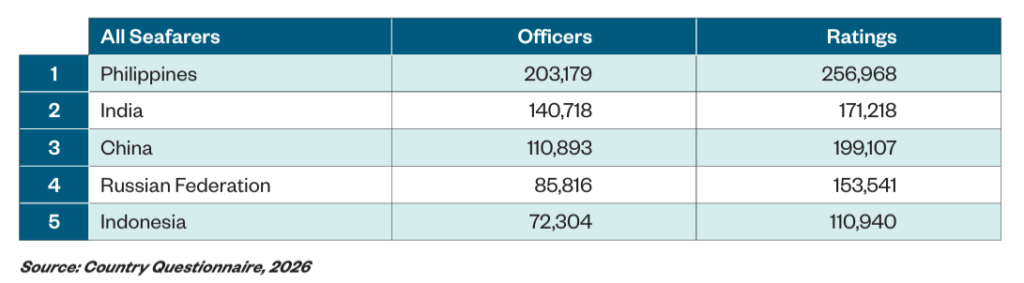
If you look at the official country questionnaires, the five largest suppliers of seafarers are:
- The Philippines: Supplying 203,179 officers and 140,718 ratings.
- India: Supplying 256,968 officers and 171,218 ratings.
- China: Supplying 110,893 officers and 85,816 ratings.
- The Russian Federation: Supplying 72,304 officers and 199,107 ratings.
- Indonesia: Supplying 153,541 officers and 110,940 ratings.
When shipping companies were asked directly about the main nationalities working on their vessels, the results were very similar. The top nationalities reported by companies include Filipinos, Ukrainians, Indians, Romanians, and Polish workers for officer positions.
For ratings, the top nationalities are Filipinos, Indians, Ukrainians, Polish, and workers from Brazil and Indonesia. This shows you that while Asian nations provide a massive share of the overall workforce, Eastern European nations also play a major role in keeping global ships staffed.
Recommended Read: What is GMDSS – Global Maritime Distress and Safety System
Demographic Trends and Gender Diversity
For the past ten years, the report has tracked demographic data to see how the workforce is changing over time. This long term view helps the industry create recruitment policies that match changing global trends and encourage diversity.
One area of major interest is gender diversity. If you are looking for signs of progress for women at sea, the report brings some positive news, though there is still a long way to go. The growth in the number of female seafarers is mostly seen in officer roles rather than ratings.
Key points regarding gender diversity include:
- The growth of female seafarers is concentrated in officer positions.
- Only one maritime administration reported a decline in female seafarers, and that decline was specifically among deck ratings.
- The vast majority of companies and administrations reported that the number of female ratings has remained stable.
This indicates that more women are pursuing higher education and advanced certifications to become officers, which is a great sign for leadership diversity in the maritime sector.
The Age Profile of Modern Seafarers
Understanding the age of the workforce helps you see whether younger people are choosing this career path or if the industry is relying on an aging population. The 2026 report collected age data from open registries that track certificate endorsements.
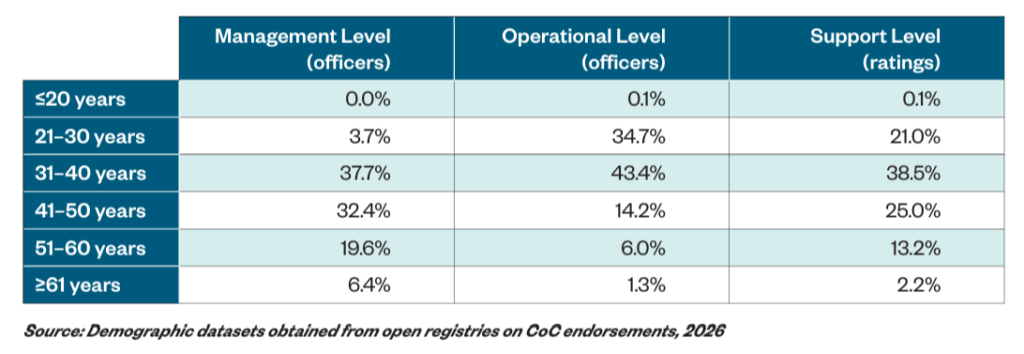
When you look at the average age profiles across different levels of responsibility, you see some interesting patterns:
Management Level Officers
These are the most senior roles on a ship. The data shows that the average age of officers at the management level has slightly decreased compared to 2021.
- There are zero percent listed under 20 years old.
- Only 3.7 percent are between 21 and 30 years old.
- The largest group is between 31 and 40 years old, making up 37.7 percent of management.
- Those between 41 and 50 years old represent 34.7 percent.
- Those between 51 and 60 years old make up 17.6 percent.
- Officers who are 61 years old or older make up 6.4 percent.
Operational Level Officers
These are junior officers who handle daily navigation and engineering tasks. Their age profile is significantly younger.
- Around 0.1 percent are 20 years old or younger.
- A large 43.4 percent are between 21 and 30 years old.
- The group between 31 and 40 years old accounts for 32.4 percent.
- Those between 41 and 50 years old stand at 14.2 percent.
- Those between 51 and 60 years old represent 6.0 percent.
- Officers aged 61 years old or older represent just 1.3 percent.
Support Level Ratings
Ratings hold the foundational operational roles on ships. Their age distribution is relatively balanced across young and middle aged adults.
- Around 0.1 percent are 20 years old or younger.
- Young adults between 21 and 30 years old make up 21.0 percent.
- The largest segment is between 31 and 40 years old, coming in at 38.5 percent.
- Workers between 41 and 50 years old represent 25.0 percent.
- Those between 51 and 60 years old make up 13.2 percent.
- Ratings who are 61 years old or older make up 2.2 percent.
This data tells you that the bulk of the operational workforce at sea consists of people between the ages of 21 and 40, which shows a solid base of young and mid career professionals.
The Global Demand for Seafarers
Now that you know how many seafarers are available, let us look at the demand side. How many workers do shipping companies actually need?
The report uses data from the Sea web database to define the size of the world merchant fleet. In 2026, the world merchant fleet consists of 85,148 ships. This is a 14 percent increase in the number of ships since 2021. Because there are more ships on the water, the need for crew members has naturally gone up.

The total demand for certified seafarers in 2026 is estimated at 2,547,790 individuals. This demand is split into:
- Demand for Officers: 1,088,080
- Demand for Ratings: 1,459,710
Overall, the total demand for seafarers has risen by 35 percent since 2021. This is a massive jump compared to the growth rates seen in previous reports from 2015 and 2021. Specifically, the demand for officers grew by 23.1 percent, while the demand for ratings surged by 46.3 percent. A big reason for the sharp increase in ratings demand was the ending of global pandemic restrictions, which allowed the shipping sector to return to normal operational levels.
Ship Types That Require the Most Crew
Not all ships are the same, and different types of vessels require different numbers of crew members. If you look at where the demand is highest, three main shipping sectors stand out.
For officers, the highest demand comes from:
- General Cargo Ships: Accounting for 21.4 percent of officer demand.
- Bulk Carriers: Accounting for 18.9 percent of officer demand.
- Cruise Ships: Accounting for 14.0 percent of officer demand.
For ratings, the sectors with the highest demand change slightly in order:
- Cruise Ships: Accounting for 22.5 percent of rating demand. This makes sense because cruise ships require huge crews to handle guest services and vessel operations.
- Bulk Carriers: Accounting for 18.4 percent of rating demand.
- General Cargo Ships: Accounting for 18.0 percent of rating demand.
Recommended Read: EU ETS in Shipping: Meaning, Impact, Challenges & Future of Maritime Decarbonization
Training, Recruitment, and Retention Challenges
Keeping a steady flow of workers entering the maritime industry is a continuous task. The report brings some good news regarding training. The number of officer cadets has grown since 2021, continuing a positive trend that started back in 2015.
The ratio of officer cadets to qualified officers is now 1 to 3.8. This is a big improvement from the 1 to 4.8 ratio in 2021 and the 1 to 7.6 ratio in 2015. It means that companies are training more entry level officers relative to the total number of senior officers employed.
Furthermore, it has become easier for officer cadets to find training positions on ships, a trend that has been improving for a decade. For rating trainees, finding a position is even easier, with nearly two thirds of companies reporting that finding a placement is easy or very easy.
However, recruitment is not without its difficulties. Shipping companies report that it is highly challenging to recruit engineering officers and deck officers. On the flip side, they find it much easier to recruit ratings for both deck and engine room positions.
This has created what economists call a K shaped result over the last five years. While the shortage of qualified officers has grown wider due to high demand, the surplus of available ratings has increased, making it easy to find general crew but hard to find specialized leaders.
The Supply and Demand Balance: Shortages and Surpluses
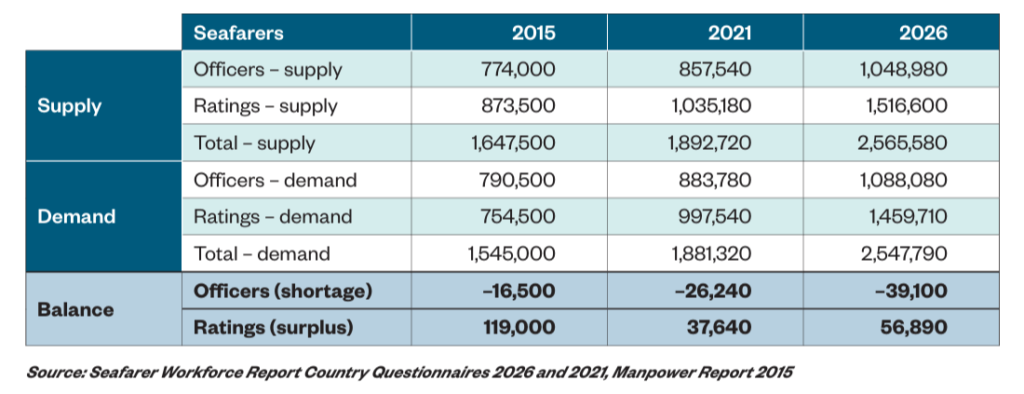
When you subtract the total demand from the total supply, you get a clear picture of the current labor market in the shipping industry. The 2026 report reveals two opposite realities:
- Officers: There is a current shortage of 39,100 officers worldwide.
- Ratings: There is a current surplus of 56,890 ratings worldwide.
To put this in perspective, look at how the numbers have shifted since 2015:
- In 2015, there was a shortage of 16,500 officers and a surplus of 119,000 ratings.
- In 2021, the officer shortage grew to 26,240, while the ratings surplus dropped to 37,640.
- In 2026, the officer shortage has reached an all time high of 39,100, while the ratings surplus has bounced back up to 56,890.
This shows that the industry is struggling to convert enough ratings or new students into fully qualified officers to match the rapid expansion of the global merchant fleet.
Looking Ahead to the Future in 2030
The report does not just look at the present year of 2026; it also projects what the industry will need by the year 2030. These forecasts are based on a baseline scenario that assumes a steady, average increase in the size of the world merchant fleet.
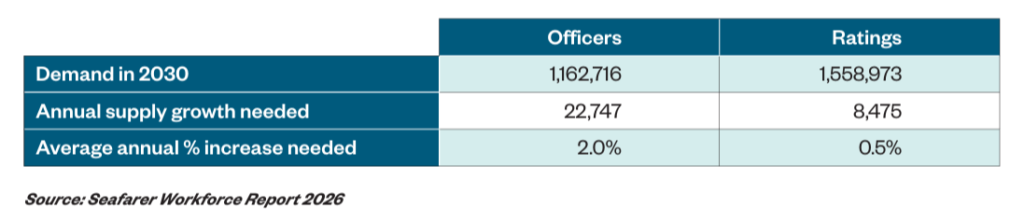
According to the baseline forecast for 2030:
- The projected demand for officers will reach 1,162,716.
- The projected demand for ratings will reach 1,558,973.
To meet this future demand for officers, the global workforce needs an additional 22,747 qualified officers to join every single year. This means the supply of officers must grow by an average of 2.0 percent annually. For ratings, the industry only needs an annual supply growth of 8,475 individuals, which is a modest 0.5 percent average annual increase.
If the fleet grows faster than expected, the shortage of officers could become even more severe, while a slower fleet growth would lower the numbers. Either way, the message is clear: the industry must focus heavily on creating new officers.
Key Recommendations for the Maritime Industry
To prevent the officer shortage from worsening and to ensure that global trade continues to move safely and efficiently, the report concludes with two vital recommendations for maritime companies, educational institutions, and governments:
- Promote Maritime Education and Careers: The industry must actively promote careers at sea to young people. This includes providing clear information on how skills learned at sea can eventually be used to transition into rewarding shore based roles later in life. Showing a clear career path is essential for long term recruitment.
- Monitor Recruitment and Retention: Maritime administrations must regularly and closely monitor the levels of seafarer recruitment and retention. By keeping a close eye on these numbers, policymakers and industry leaders can stay informed and react quickly to shifts in the global supply and demand situation.
The Seafarer Workforce Report 2026 makes it clear that while the maritime workforce is growing, the demand for highly skilled officers is outrunning the supply. If you are involved in shipping or considering a career in the maritime sector, focusing on advanced training and officer qualifications is the most valuable step you can take today.
Recommended Read: Global Conflicts in 2026: How the Middle East War Is Driving the Red Sea Crisis and Impacting Global Shipping
Frequently Asked Questions
1. What is the main problem facing the global shipping workforce in 2026?
The global shipping industry is currently facing a large shortage of qualified officers who lead the ships, while having a surplus of ratings who handle general crew work. This gap has grown wider because the world merchant fleet is expanding faster than new officers are being trained.
2. Which countries supply the largest number of seafarers to the world fleet?
The top five countries supplying seafarers are India, the Philippines, Indonesia, China, and the Russian Federation. Together, these five nations provide more than half of the entire global maritime workforce.
3. Why did the demand for seafarers jump so significantly since 2021?
Demand rose by 35 percent because the global merchant fleet grew to over 85,000 ships to handle increased international trade. Additionally, the lifting of pandemic restrictions allowed the cruise and cargo sectors to return to full operational capacity.
4. What does the report say about women working in the maritime industry?
The report shows that the number of female seafarers is growing, with most of this increase happening in high-level officer positions rather than general ratings. This is a positive sign that more women are pursuing advanced training and leadership roles at sea.
5. How many new officers does the shipping industry need to recruit every year by 2030?
To keep up with the growing number of ships, the global maritime workforce needs an additional 22,747 qualified officers to join the industry each year. This requires the total supply of officers to grow by a steady 2 percent annually over the next few years.