
As of mid March 2026, the world is facing a period of intense geopolitical instability. While multiple conflicts are ongoing across different regions, the most critical and impactful situation is the escalating Middle East war involving the United States, Israel, and Iran.
Table of Contents
This conflict is not limited to land or air. It has expanded into the maritime domain, especially the Red Sea, turning one of the world’s most important trade routes into a high risk zone. The result is a direct impact on global trade, the merchant navy industry, and seafarers across the world, including a large number of Indians.
The Core Conflict in the Middle East
The current crisis is being driven by a sharp escalation between major powers in the Middle East.
- The United States and Israel launched large scale airstrikes on Iran targeting nuclear facilities, oil infrastructure, and key leadership positions.
- These strikes were part of a broader effort to weaken Iran’s military and strategic capabilities.
- Iran responded with missile attacks targeting Israel and U.S. allied Gulf countries, increasing the risk of a wider regional war.
- Reports indicate that several high ranking Iranian officials were killed, which has further intensified tensions.
- At the same time, conflicts continue in Gaza, Lebanon, and Syria, creating a multi front war situation across the region.
This has turned the Middle East into a highly unstable zone with both direct and indirect conflict involving multiple actors.
How This Middle East War Is Directly Linked to the Red Sea Crisis
The Red Sea attacks are not isolated incidents but are deeply connected to the larger conflict.
- Yemen’s Houthi forces, who are aligned with Iran, have increased attacks on commercial ships in the Red Sea.
- These attacks are seen as part of a broader strategy to pressure the United States, Israel, and their allies through economic disruption.
- The timing of increased Red Sea attacks closely matches the escalation of the Iran Israel conflict.
- Commercial vessels, oil tankers, and cargo ships are being targeted regardless of whether they are directly involved in the conflict.
- This has effectively turned the Red Sea into an extension of the Middle East battlefield.
In simple terms, the war has expanded from land into critical global sea routes.
Global Trade and Economic Impact
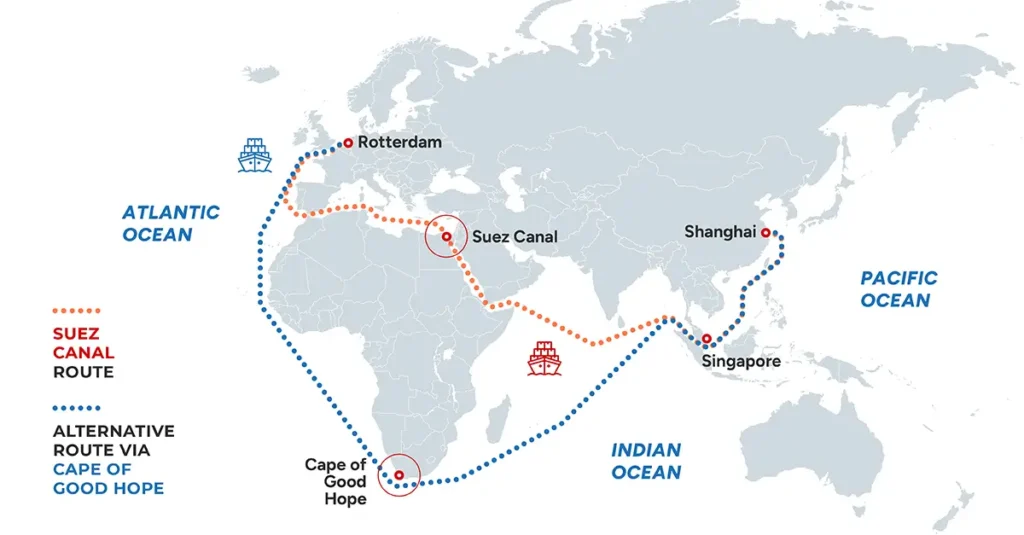
Image source: Operinter
The Red Sea is one of the most important maritime routes in the world, and its disruption has global consequences.
- Nearly 12 percent of global trade passes through the Red Sea, making it a critical link between Europe and Asia.
- Shipping companies are avoiding this route and rerouting vessels around the Cape of Good Hope, which significantly increases travel distance.
- These longer routes are adding weeks to delivery times, which is disrupting global supply chains.
- Fuel consumption has increased due to longer journeys, leading to higher shipping costs.
- Insurance premiums for ships passing through high risk areas have increased sharply due to war related risks.
- Oil supply chains are under pressure because attacks are also targeting energy infrastructure in the Gulf region.
As a result, global markets are experiencing rising costs, delays, and increased uncertainty.
Impact of the Middle East War on the Global Merchant Navy
The merchant navy is at the center of this crisis as it is responsible for maintaining global trade flow.
- Shipping companies are facing difficult decisions between safety and operational efficiency.
- Longer routes are increasing operational costs, including fuel, maintenance, and crew expenses.
- War risk insurance has become a major financial burden for shipping operators.
- Port congestion is increasing due to delays, affecting global logistics networks.
- Naval forces from multiple countries are now actively protecting shipping lanes, showing the seriousness of the situation.
The industry is operating under pressure while trying to ensure that global trade continues without major interruptions.
The Human Impact on Seafarers
Seafarers are the most directly affected individuals in this crisis.
- Seafarers are working in conditions where there is a constant threat of missile, drone, or hijacking attacks.
- Many crew members are experiencing high levels of stress due to uncertainty and safety concerns.
- Longer routes are increasing the time seafarers spend onboard, leading to fatigue and mental strain.
- Crew changes are becoming more difficult due to delays and disrupted schedules.
- Most seafarers have limited control over their assignments and must continue working despite the risks.
This has turned routine maritime operations into high risk missions for many crews.
Impact on India and Indian Seafarers
India is closely connected to this crisis both economically and through its workforce.
- India relies heavily on the Middle East for oil imports, making it sensitive to disruptions in the region.
- A significant portion of India’s trade passes through routes affected by the Red Sea crisis.
- Thousands of Indian seafarers are currently working on ships operating in or near high risk areas.
- Families of seafarers are facing anxiety due to safety concerns.
- Rising fuel prices and shipping costs are affecting the Indian economy and increasing inflationary pressure.
- The Indian government has increased monitoring and issued advisories to ensure the safety of its citizens.
This makes India both economically and socially impacted by the ongoing situation.
Other Global Conflicts Adding to the Pressure
While the Middle East is the main focus, other conflicts are contributing to global instability.
- The war in Ukraine continues, although global attention has shifted due to the Middle East crisis.
- In Africa, tensions in Sudan, Ethiopia, Eritrea, and Congo are increasing instability in the region.
- In Asia, tensions between Pakistan and Afghanistan have escalated, affecting regional peace.
- In Latin America, ongoing violence and instability continue to impact internal security.
These conflicts together are creating a complex global environment where multiple risks are emerging at the same time.
A New Reality of Interconnected Conflicts
The current situation highlights how interconnected the modern world has become.
- Military actions in one country are triggering responses across multiple regions.
- Regional conflicts are now directly impacting global trade routes and economic systems.
- Maritime routes are being used as strategic pressure points in geopolitical conflicts.
- Countries that are not directly involved in the war are still facing economic and operational consequences.
The Red Sea crisis is a clear example of how local conflicts can quickly turn into global disruptions.
What Lies Ahead
The future of this situation remains uncertain and depends on how the conflict evolves.
- Continued military escalation could lead to more attacks on ships and energy infrastructure.
- Diplomatic efforts may help reduce tensions but will require cooperation from multiple countries.
- Shipping companies may continue to avoid high risk areas if the situation does not improve.
- Global markets may remain unstable due to uncertainty in energy supply and trade routes.
The outcome will depend on whether the situation moves towards escalation or de escalation.
Conclusion
The escalating Middle East war in 2026 is not just a regional conflict. It is directly connected to the Red Sea crisis and is affecting global trade, shipping, and seafarers.
The merchant navy industry is facing one of its most challenging periods in recent years. Ships continue to operate, but under increased risk and cost pressures.
Seafarers, including a large number of Indians, are working in difficult and uncertain conditions to keep global trade moving.
This situation clearly shows that in today’s interconnected world, conflicts do not remain limited to one region. Their impact spreads across the globe, affecting economies, industries, and human lives.
Frequently Asked Questions
1. Why has the conflict in the Middle East expanded into the Red Sea?
The Red Sea has become a maritime extension of the battlefield as Iran-aligned Houthi forces target commercial vessels to exert economic pressure on the U.S. and Israel. This strategy links land-based military strikes directly to global trade disruptions.
2. How is the rerouting of ships around the Cape of Good Hope affecting global trade?
Avoiding the Red Sea adds weeks to delivery times and thousands of miles to journeys, leading to a sharp rise in fuel consumption and shipping costs. These delays disrupt global supply chains and cause insurance premiums for vessels to skyrocket.
3. What is the specific impact of this crisis on Indian seafarers?
Thousands of Indian seafarers are facing extreme physical danger from missile and drone attacks while experiencing high mental stress due to prolonged shifts and uncertain safety. Their role has shifted from routine maritime work to high-risk missions in a volatile war zone.
4. Why is India particularly vulnerable to these maritime disruptions?
India is heavily dependent on the Middle East for oil imports and uses these affected sea routes for a massive portion of its international trade. The resulting increase in shipping costs and fuel prices creates significant inflationary pressure on the Indian economy.