
If you are planning to step into the world of the Merchant Navy or work onboard any sea-going vessel, STCW courses are your non-negotiable gateway. Whether you want to work on a massive container ship, an oil tanker, or a luxury cruise liner, you cannot embark without these certifications.
Table of Contents
Understanding which STCW courses you need, how much they cost, and how to enroll can feel overwhelming when you are starting out. This comprehensive guide breaks down everything you need to know about mandatory STCW courses in India, from basic safety training to advanced modular certifications.
What is STCW Courses?
STCW is short for the Standards of Training, Certification, and Watchkeeping. As the name implies, STCW sets the standards for all seafarers who are required to work on every foreign-going, near-Coastal Vessel, and other pleasure craft. It ensures that seafarers are well-trained to work efficiently in emergencies such as fire, flooding, pirate attacks, etc.
STCW courses are a group of courses that are mandatory to complete before going on board the ship. Once you complete the STCW Course and clear all the exams then you will get a certificate implementing that you are eligible to work onboard ship. After getting the certificate, you will be eligible to work on ship for 5 years as the certificates are valid for 5 years of time period.
The STCW standards cover various safety and emergency response skills that are crucial for all crew members on board a vessel.
Why are STCW Courses Important?
Safety at sea is entirely different from safety on land. When an emergency happens in open waters, immediate external help is rarely available. You and your fellow crew members are the first and only line of defense.
- STCW courses teach important skills to save lives in emergencies.
- Seafarers learn hands-on how to handle different emergencies.
- These courses help seafarers protect themselves, crew members, and passengers.
- Without STCW training, seafarers wouldn’t be ready for unexpected challenges at sea.
STCW Courses Fees
STCW Courses fees vary from college to college. Generally, the fees of STCW courses range from ₹5000 to ₹20,000 depending on the college and course you are doing. To check the fees of any particular college, you usually need to visit their website and then find the fees of the STCW courses, many times you need to call the college and wait for them to confirm the availability of the seat for the SCTW course.
STCW Courses List
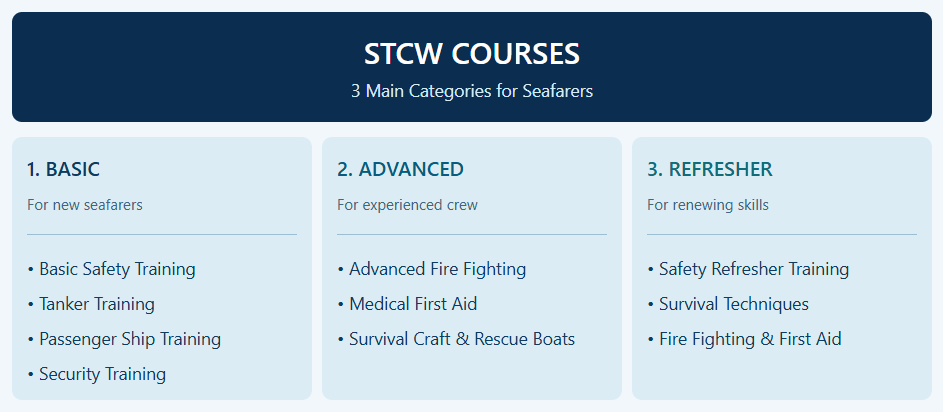
STCW courses are structured systematically to support seafarers at every phase of their maritime career. They are broadly categorized into 3 distinct groups:
- STCW Basic Modular Courses
- STCW Advanced Modular Courses
- STCW Refresher Courses
STCW Basic Courses
The STCW Basic Modular Courses are designed for new seafarers starting their maritime careers. These courses teach essential skills such as personal safety, social responsibility, basic firefighting, and emergency response. The modular setup allows trainees to learn each skill step by step, making it easier to prepare for the final exam.
Here is a closer look at the key entry level modular courses every beginner must complete:
1. Basic STCW Safety Training (BST)
Basic Safety Training is the most fundamental qualification required for anyone stepping onboard a sea-going vessel. It builds your core survival instincts and equips you with essential safety habits. It combines 4 basic modules:
- Personal Survival Techniques (PST): Teaches you how to survive in open water, launch lifeboats, and use life-saving equipment properly.
- Fire Prevention and Fire Fighting (FPFF): Trains you to identify fire hazards and extinguish onboard fires using specialized equipment.
- Elementary First Aid (EFA): Teaches vital medical practices such as CPR, bandaging wounds, and handling medical shocks until a doctor is available.
- Personal Safety and Social Responsibilities (PSSR): Prepares you for living and working onboard, focusing on ship discipline, safety protocols, and teamwork.
2. Basic Training for Liquefied Gas Tanker Cargo Operations (LGTF)
If your goal is to work on gas carriers, this specialized course is required. It trains you in:
- Properties and physical hazards of liquefied gases.
- Operating cargo handling systems safely.
- Emergency response procedures specific to gas leaks or fires.
3. Oil and Chemical Tanker Cargo Operations (OCTCO / TFC-COM)
This course is targeted at seafarers aiming for high-paying roles on oil and chemical tankers. Key learning areas include:
- Safe loading, unloading, and handling of liquid hazardous cargoes.
- Marine pollution prevention protocols.
- Tanker safety regulations and tank washing procedures.
4. Personal Safety & Social Responsibilities (PSSR)
While included as part of BST, PSSR specifically focuses on how you adapt to life at sea. It highlights safe working practices, onboard communication, environmental protection, and adjusting to living in close quarters with international crews.
5. Passenger Ship Familiarization (PSF)
If you wish to work on cruise liners or passenger ferries, you must complete this training. It emphasizes crowd management, passenger communication during emergencies, and organized evacuation procedures.
6. Security Training for Seafarers with Designated Security Duties (STSDSD)
In compliance with global ISPS security rules, this course equips crew members to recognize security threats, prevent unauthorized access, and respond effectively to piracy risks.
Recommended Read: INDoS Number: How to Apply (Complete Guide)
STCW Advanced Courses
The STCW Advanced Modular Courses are designed for experienced seafarers looking to enhance their maritime skills. These courses cover advanced topics such as firefighting, emergency management, medical care, and survival techniques. The modular structure allows trainees to focus on each advanced skill individually, ensuring thorough preparation for the final exam.
Common advanced courses include:
- Advanced Fire Fighting (AFF): Teaches command strategies, fire control organization, and advanced tactical firefighting onboard.
- Medical First Aid (MFA) & Medical Care: Deepens medical training so senior officers can manage serious medical conditions and illnesses at sea.
- Proficiency in Survival Craft and Rescue Boats (PSCRB): Focuses on launching and managing survival craft, rescue boats, and life-saving appliances during critical abandon-ship scenarios.
STCW Exit Exam Refresher Courses
The STCW Exit Exam Refresher courses are for seafarers who need to renew their certifications to stay compliant for duty onboard ship. This exit exam ensures that seafarers maintain their knowledge and skills, covering essential areas such as firefighting, personal survival techniques, and first aid. The refresher course is mandatory for those whose certifications are nearing expiration and provides updated training to keep up with the latest safety protocols.
STCW Courses in India
In India, DG Shipping is the regulatory body that looks over the complete process of STCW courses for each seafarer in every DG-certified College. To complete the STCW you also need to apply and complete the lessons from the DG Shipping Portal. This portal tracks your progress, ensuring that all mandatory training is completed. Additionally, certificates issued through DG Shipping are recognized internationally, enhancing your credibility as a certified seafarer.
STCW E-Learning
You might have heard about STCW training if you’re working in the maritime industry. Usually, you have to attend a training center for these courses. But with STCW e-learning, you don’t always have to. Instead of sitting in a classroom, you can complete some of the courses online from wherever you are!
Think of it like this: you get access to all the study materials, video lessons, and even tests on your computer or phone. Some courses can be done completely online, while others might require you to visit a training center for the practical part and final assessment. It’s super convenient, especially if you’re working or can’t travel easily. Plus, these online courses are approved by DG Shipping (India) and the IMO.
Recommended Read: Safety and Operations in the Merchant Navy
How to Choose the Right STCW Course?
A common mistake many freshers make is enrolling in multiple courses without a clear direction. In reality, your course selection should always align with the type of vessel you aim to join and the career path you’re planning to build.
No matter which ship or position you are targeting, STCW courses are mandatory. Basic Safety Training (BST), Personal Safety & Social Responsibilities (PSSR), and Elementary First Aid (EFA) are mandatory for every seafarer. These form the foundation and are required before stepping onboard any vessel.
Once these essential STCW courses are completed, you can then move forward strategically by choosing additional certifications based on your preferred sector. If you’re aiming for tanker vessels, courses like oil and chemical tanker operations or gas tanker training become relevant. Similarly, if your goal is to work on passenger or cruise ships, you can opt for passenger ship familiarization and security-related training.
The idea is simple: build your base first, then specialize based on your target ship type, instead of doing everything at once without a plan.
FAQs
What is STCW Fullform?
STCW stands for Standards of Training, Certification, and Watchkeeping for Seafarers.
What are STCW Courses?
STCW courses are mandatory safety and operational training modules required for all seafarers before working onboard sea-going vessels. They cover survival, firefighting, first aid, personal safety, and specialized ship operations.
How much do STCW courses cost?
In India, basic STCW courses typically range between ₹5000 and ₹20,000 depending on the institute, location, and individual modules selected.
Who needs STCW Courses?
Anyone planning to work at sea requires STCW courses. This includes deck cadets, engine cadets, ratings (GP Rating, Wiper, OS), hospitality staff on cruise ships, and offshore vessel personnel.
How to Pass STCW Courses?
To pass STCW courses, you must complete the DG Shipping online e-learning modules, attend compulsory physical and practical sessions at an approved institute, and successfully clear the online exit exam.
