
If you have ever stood on a coastline, watched a massive cargo ship disappear over the horizon, and wondered how dozens of crew members manage to keep that floating city running smoothly for weeks at a time, the answer comes down to a carefully structured hierarchy.
Life on board a commercial vessel depends on a precise chain of command where every single person, from the trainee cadet to the captain, knows their exact role, watch hours, and responsibilities.
Whether you are thinking about starting a career in the merchant navy, recruiting seafarers, or just curious about what goes on behind the scenes at sea, getting to know the ship rank hierarchy is the ultimate starting point.
In this guide, you will get a complete breakdown of how ship departments operate, how officers and ratings work together, and how career progression unfolds from your very first day on board all the way to taking full command of the ship.
The Deck Department
The deck department handles ship navigation, vessel stability, communication, cargo management, and overall onboard safety.
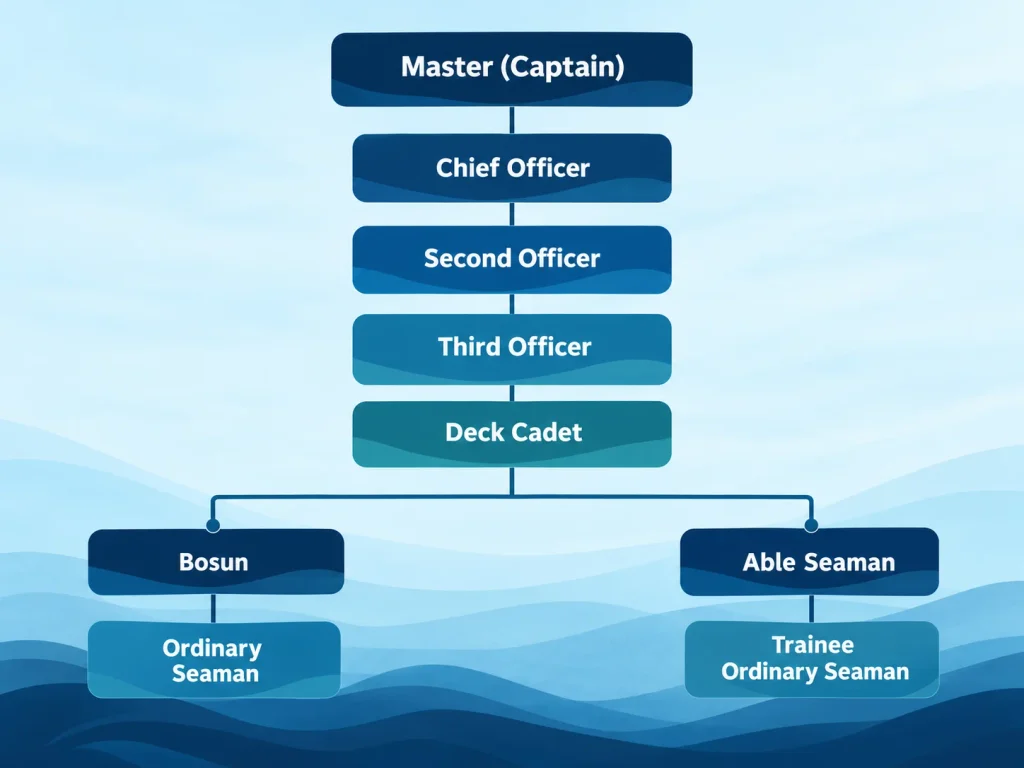
Deck Officers
- Master (Captain): The Master holds the ultimate authority on board the ship. They carry total legal accountability for the safety of the crew, vessel, cargo, and marine environment. To reach this command position, you must hold a STCW II/2 Certificate of Competency Class 1 as a Master Mariner.
- Chief Officer (Chief Mate): As second in command on the deck side, the Chief Officer directly assists the Master and manages cargo planning, vessel stability calculations, and onboard safety management. Their working watch schedules run from 0400 hours to 0800 hours and from 1600 hours to 2000 hours. They hold a STCW II/2 Certificate of Competency Class 2.
- Second Officer: The Second Officer acts as the primary navigational officer. They handle passage planning, maintain nautical charts, keep official publications current, and act as the primary medical officer on board. Their navigational watches run from 1200 hours to 1600 hours and from 0000 hours to 0400 hours. They hold a STCW II/1 Certificate of Competency Class 2.
- Third Officer: Serving as the ship safety officer, the Third Officer monitors and maintains all life-saving equipment and firefighting systems. They keep navigational watch between 0800 hours to 1200 hours and 2000 hours to 0000 hours, and they manage port documentation required by the Master. They hold a STCW II/1 Certificate of Competency Class 3.
- Deck Cadet: Deck Cadets are trainee officers working under the direction of senior officers to build practical navigation and cargo handling skills while working toward their initial professional marine licenses.
Deck Crew (Ratings)
- Bosun: The Bosun serves as the senior rating on deck, coordinating daily deck maintenance and operational tasks assigned by the Chief Officer.
- Able Seaman (AB): Able Seamen carry out watchkeeping support, steering, and general deck operations.
- Ordinary Seaman (OS): Ordinary Seamen handle cleaning, surface preparation, painting, wire splicing, and general cargo equipment maintenance.
- Trainee Ordinary Seaman: This is the entry level deck rating position designed to help new mariners build practical seamanship experience.
The Engine Department
The engine department powers the ship. This team manages the main propulsion engines, auxiliary power units, fuel systems, electrical networks, and mechanical plant maintenance.
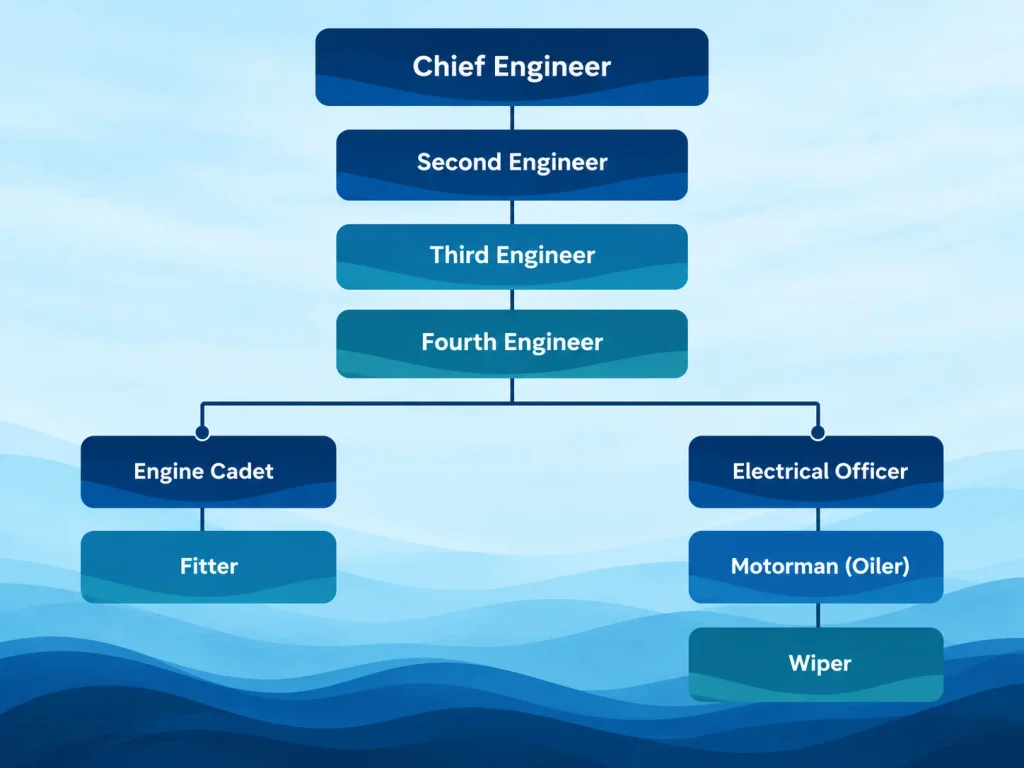
Engine Officers
- Chief Engineer: The Chief Engineer manages the entire technical department and oversees fuel management, mechanical maintenance, and technical compliance with international environmental standards like SOLAS and MARPOL. They hold equal operational seniority to the Chief Officer and report directly to the Master. Qualifications require a STCW III/2 Certificate of Competency Class 1.
- Second Engineer: The Second Engineer manages daily engine room operations, plans machinery maintenance schedules, and supervises junior engineers and trainees. They hold a STCW III/2 Certificate of Competency Class 2.
- Third Engineer: The Third Engineer manages auxiliary machinery, boilers, fuel transfers, emergency pumping units, and air compressors under the Chief Engineer’s oversight. Qualifications require a STCW III/1 Certificate of Competency Class 3.
- Fourth Engineer: The Fourth Engineer handles purifiers, air compressor systems, electrical machinery, sewage units, and HVAC systems. They report to the Second Engineer and hold a STCW III/1 Certificate of Competency Class 3.
- Fifth Engineer / Engine Cadet: Engine Cadets work directly under senior engineers to gain practical experience taking fluid soundings, maintaining machinery, and using workshop tools.
- Electrical Officer (ETO): The Electrical Officer manages complex electrical distribution networks, computer automation systems, and electronic instrumentation across the entire ship.
Engine Crew (Ratings)
- Fitter: The Fitter carries out precision mechanical repairs, metal fabrication, assembly work, and structural welding in the ship workshop.
- Motorman (Oiler): Motormen monitor running plant equipment, maintain lubrication systems, take machine readings, and assist watch officers.
- Wiper: Wipers assist engine room personnel by maintaining technical space cleanliness and supporting general mechanical overhaul work.
Recommended Read: Deck vs Engine: Which Merchant Navy Career Path Fits You Best?
The Catering Department
The catering department manages food preparation, nutritional needs, cabin sanitation, and general crew welfare.
- Chief Cook: The Chief Cook manages galley operations, prepares daily meals, handles food inventory, monitors store rooms, and enforces strict hygiene standards set by global maritime regulations.
- Trainee Cook: The Trainee Cook assists the Chief Cook with food preparation and inventory management while gaining sea service time.
- Steward: Stewards handle meal service, clean accommodation areas, manage laundry facilities, and assist with store inventory records.
Comparing Ratings and Officers
Understanding the key differences between officers and ratings helps clarify how responsibilities are distributed on board:
| Feature | Ratings | Officers |
| Qualifications | Basic Safety Training (BST), proficiency certificates | CoC Class 1, Class 2, or Class 3 (STCW) |
| Authority | Work under direct supervision | Hold official watchkeeping authority |
| Typical Entry | 10th or 12th standard education plus pre-sea training | B.Sc. Nautical Science or Marine Engineering degree |
| Monthly Salary | Rs. 35,000 to Rs. 1,20,000 | Rs. 1,50,000 to Rs. 8,00,000+ |
| Career Advancement | Progress through rating tiers or take CoC examinations | Advance through watchkeeping officer ranks |
Career Progression: Deck Cadet to Master
The career path in the merchant marine follows structured training milestones governed by maritime regulatory bodies:
- Deck Cadet: Complete a B.Sc. in Nautical Science and serve 12 months of sea service as a cadet.
- Third Officer: Pass marine authority examinations to earn a Certificate of Competency Class 3 and begin working as a navigational watchkeeping officer.
- Second Officer: Accumulate 18 to 24 months of sea experience, complete required training modules, and earn a Certificate of Competency Class 2.
- Chief Officer: Pass the Certificate of Competency Class 2 Chief Mate examination to manage deck operations and cargo handling.
- Master (Captain): Serve for more than one year as Chief Officer and earn a Certificate of Competency Class 1 as a Master Mariner.
Monthly Earnings by Rank
Salaries in international shipping vary based on vessel type, flag state, and employer specifications. The table below shows typical monthly pay ranges for Indian maritime officers on international commercial ships:
| Rank | Average Monthly Pay (INR) | Experience Required |
| Master (Captain) | Rs. 6,00,000 to Rs. 9,00,000 | 12+ years |
| Chief Engineer | Rs. 5,50,000 to Rs. 8,50,000 | 12+ years |
| Chief Officer | Rs. 3,50,000 to Rs. 5,50,000 | 6 to 10 years |
| Second Engineer | Rs. 3,00,000 to Rs. 5,00,000 | 6 to 10 years |
| Second Officer | Rs. 2,00,000 to Rs. 3,50,000 | 3 to 6 years |
| Third Officer / 4th Engineer | Rs. 1,50,000 to Rs. 2,50,000 | 0 to 3 years |
| Able Seaman / Ratings | Rs. 60,000 to Rs. 1,20,000 | Varies |
Income earned by qualified seafarers during required qualifying time at sea remains exempt from taxes under national income tax laws.
Every role on a merchant vessel contributes directly to safe transport across international ocean routes. Clear division of duties between deck, engine, and catering departments ensures smooth operational coordination from the moment a ship leaves port until it arrives safely at its destination.
Recommended Read: Merchant Navy Salary in India 2026: Rank Wise Pay Scale (Deck Cadet to Captain)
FAQs
1. What is the main difference between Deck Officers and Engine Officers?
Deck Officers manage navigation, cargo operations, vessel stability, and overall ship safety on the bridge. Engine Officers maintain the main engines, auxiliary power generators, electrical systems, and technical machinery in the engine room.
2. How long does it take to progress from a Deck Cadet to a Master Mariner?
It typically takes around 10 to 12 years of structured sea service, additional training modules, and passing required marine authority examinations to advance from an entry level Deck Cadet to a Captain.
3. Do ratings need a marine engineering or nautical science degree to join a ship?
No, ratings generally join after completing their 10th or 12th standard education along with mandatory pre-sea training and Basic Safety Training certificates under international standards.
4. Is seafarer income tax free on international vessels?
Yes, income earned at sea by seafarers who meet the minimum sea time requirements in an assessment year qualifies for tax exempt status under national tax laws.
5. Who is third in command on the deck department hierarchy?
The Second Officer is third in command on the deck side, serving as the primary navigational officer responsible for passage planning, updating charts, and providing medical aid on board.
