
If you are thinking about joining the Merchant Navy, one of the first questions on your mind is probably about money. How much can you actually earn? Does the salary grow fast? Is the pay really tax free? You are not alone in asking this. Salary is one of the biggest reasons young Indians choose this career over a regular shore job.
In this guide, you will get a clear, rank wise breakdown of what you can expect to earn in the Merchant Navy in 2026, from the day you join as a Deck Cadet to the day you become a Captain or Chief Engineer. We will also cover how the pay structure works, what affects your salary, and how you can grow your income faster.
Why Merchant Navy Salaries Stand Out
Before we get into the numbers, it helps to understand why this career pays so well compared to many shore based jobs at the same experience level.
- You get paid in US Dollars by most international shipping companies, even if you are Indian.
- Your income is largely tax free in India if you qualify as a Non Resident Indian (NRI) by staying outside the country for the required number of days.
- You do not have living expenses on board. Food, accommodation, and travel to the ship are usually covered by the company.
- Salary growth with each promotion is much faster than what you see in most shore jobs.
This combination of tax free income, no daily expenses, and quick promotions is why so many young sailors end up saving a large part of their salary.
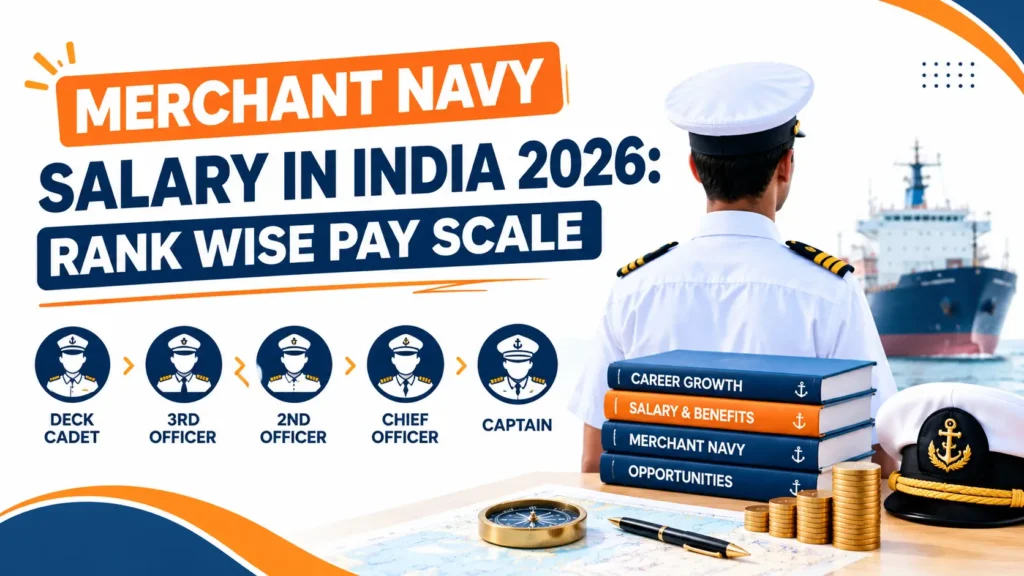
How Merchant Navy Salary Is Structured
Your total pay on a ship is not just one number. It usually includes a few different parts.
- Basic pay: the fixed monthly salary tied to your rank.
- Allowances: extra pay for things like leave, subsistence, and any special cargo you are handling.
- Overtime pay: many companies pay extra for work done beyond standard hours, which can add a meaningful amount to your monthly income.
- High risk area bonus: if your ship passes through regions considered risky, such as certain parts of the Gulf or areas with piracy concerns, you get an additional bonus for that period.
So when people quote a salary figure, they usually mean the total monthly package, not just the basic pay.
Deck Department Salary: Rank Wise Breakdown
The deck department handles navigation, cargo operations, and the overall safety of the ship. Here is what you can expect to earn at each rank in 2026.
| Rank | Average Monthly Salary (INR) |
| Deck Cadet (Trainee) | Rs 30,000 to Rs 85,000 |
| Third Officer | Rs 1.5 Lakh to Rs 3.5 Lakh |
| Second Officer | Rs 3.5 Lakh to Rs 5.5 Lakh |
| Chief Officer | Rs 6.5 Lakh to Rs 10 Lakh |
| Captain (Master) | Rs 9 Lakh to Rs 20 Lakh and above |
As you can see, the jump from Third Officer to Chief Officer is significant. This is one of the reasons many sailors work hard to clear their Chief Mate and Master exams as quickly as possible.
Engine Department Salary: Rank Wise Breakdown
The engine department is responsible for keeping the ship’s machinery, engines, and power systems running smoothly. Their pay scale looks like this.
| Rank | Average Monthly Salary (INR) |
| Trainee Engineer / Engine Cadet | Rs 30,000 to Rs 85,000 |
| Fourth Engineer | Rs 1.5 Lakh to Rs 3 Lakh |
| Third Engineer | Rs 2.5 Lakh to Rs 4 Lakh |
| Second Engineer | Rs 4 Lakh to Rs 6.5 Lakh |
| Chief Engineer | Rs 7 Lakh to Rs 12 Lakh and above |
Engineers who specialize further, for example by getting certified for LNG or gas carriers, often earn on the higher end of these ranges or beyond.
Ratings and Support Staff Salary
Not everyone on board is an officer. Ratings and support staff also form a big part of the crew, and their pay has improved steadily over the past few years.
| Position | Average Monthly Salary (INR) |
| Ordinary Seaman / Wiper | Rs 25,000 to Rs 45,000 |
| Able Seaman / Oiler | Rs 40,000 to Rs 70,000 |
| Bosun / Pumpman | Rs 55,000 to Rs 90,000 |
| Cook / Steward | Rs 35,000 to Rs 60,000 |
Ratings can also work their way up to officer ranks over time through additional training and exams, which opens the door to much higher pay.
What Affects Your Salary
Your rank is not the only thing that decides how much you earn. A few other factors matter just as much.
- Type of ship: tankers, especially chemical and LNG carriers, generally pay more than bulk carriers or general cargo ships because the work involves more risk and technical skill.
- Company you sail with: well established shipping companies with good safety records often pay better and more consistently than smaller ones.
- Experience and sea time: the more sea time you accumulate, the stronger your negotiating position becomes for future contracts.
- Route and area of operation: routes that pass through high risk zones usually come with additional bonus pay.
- Certifications: extra certifications like tanker endorsements or specialized cargo handling courses can boost your pay even at the same rank.
Understanding the Tax Free Benefit
Many people ask if Merchant Navy salary is really tax free, and the honest answer is that it depends on your residency status. To qualify as a Non Resident Indian and enjoy tax free income, you generally need to spend fewer than 184 days in India during the financial year and receive your salary in a Non Resident External account. If you meet these conditions, your seafaring income is not taxed in India. This is a major reason the take home pay in this career feels much higher compared to a shore job with a similar gross salary.
How Your Salary Grows Over the Years
One thing that surprises many newcomers is just how quickly pay can grow if you stay consistent with your exams and sea time.
- In your first year as a cadet, your pay is modest, mainly meant to cover training and basic needs.
- By the time you become a Second Officer or Second Engineer, usually within four to six years, your salary can be five to six times your starting pay.
- Reaching Chief Officer or Chief Engineer typically takes seven to ten years and comes with another major jump in income.
- Becoming a Captain or Chief Engineer, the top ranks, usually takes ten to fifteen years depending on how quickly you clear your exams and gain sea time.
Tips to Increase Your Merchant Navy Salary
If you want to earn more and move up faster, keep these points in mind.
- Clear your competency exams as early as your sea time allows, since delays directly delay your next pay jump.
- Consider specializing in tanker or gas carrier operations, since these segments generally pay a premium.
- Build a strong record with reliable companies, since good performance reviews often lead to better contracts and faster promotions.
- Keep your certifications and STCW courses updated so you are always eligible for new opportunities without waiting.
Final Thoughts
A career in the Merchant Navy offers one of the fastest salary growth paths available to young Indians today, along with the added benefit of tax free income for those who qualify as NRIs. Whether you are just starting out as a Deck Cadet or aiming for the Captain’s chair, understanding how the pay structure works will help you plan your career and your finances better. Stay focused on your exams, choose your ship type wisely, and the income will follow.
FAQs
1. Is Merchant Navy salary really tax free in India?
Yes, if you qualify as a Non Resident Indian by staying outside India for the required number of days and receive your salary in an NRE account, your seafaring income is not taxed.
2. What is the starting salary of a Deck Cadet in the Merchant Navy?
A Deck Cadet typically earns between Rs 30,000 and Rs 85,000 per month, depending on the company and type of ship.
3. How long does it take to become a Captain in the Merchant Navy?
It usually takes 10 to 15 years, depending on how quickly you clear your competency exams and gain the required sea time.
4. Which pays more, tankers or bulk carriers?
Tankers, especially chemical and LNG carriers, generally pay more than bulk carriers because the work involves more technical skill and higher risk.
5. Do ratings earn less than officers in the Merchant Navy?
Yes, ratings earn less than officers, but they can move up to officer ranks over time through additional training and exams, which leads to much higher pay.
