
When you look at a world map, some places might look like small and simple stretches of water. However, these narrow water passages often hold the power to shape global history, impact daily life, and control the global economy. One such place is the Strait of Hormuz. Located in the Middle East, this specific waterway is one of the most critical marine locations on Earth.
If you have ever wondered why a single body of water makes the news so frequently, you are about to find out. From the oil that powers global transportation to unique marine animals and ancient history, this waterway has many secrets. Here are 11 essential facts about the Strait of Hormuz that you must know.
Table of Contents
1. It Has a Highly Strategic Location
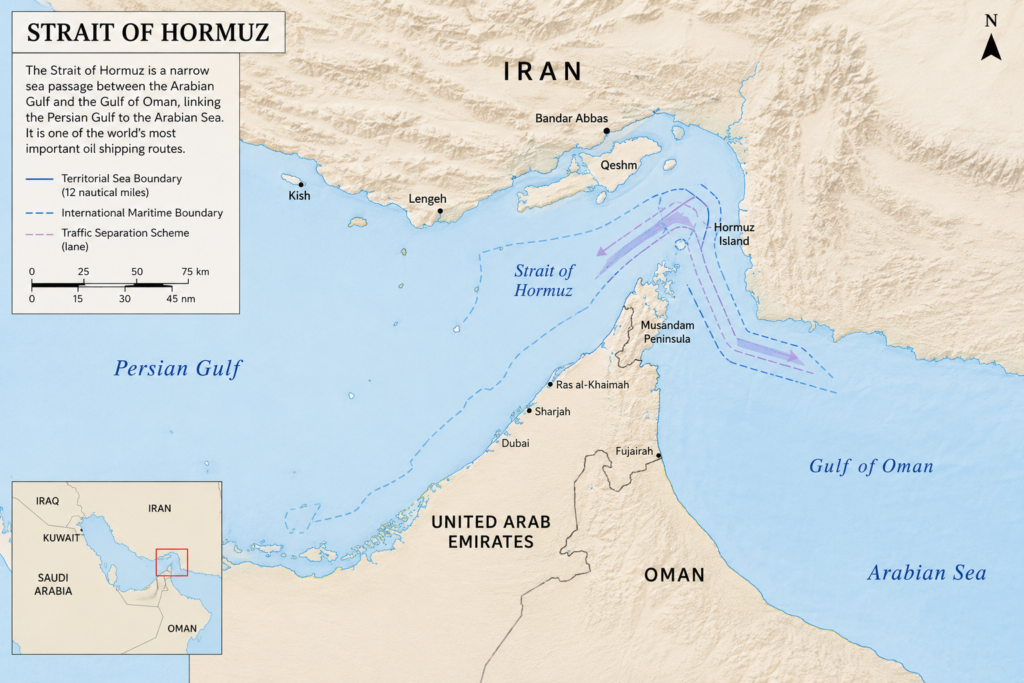
To understand why this waterway is so important, you first need to look at its location. The Strait of Hormuz is the only sea passage that connects the Persian Gulf to the open waters of the Gulf of Oman and the Arabian Sea, which leads directly into the Indian Ocean.
- On the northern side of the waterway sits the country of Iran.
- On the southern side sits the Musandam Peninsula, which is a piece of land shared by the United Arab Emirates and Oman.
Because of this unique position, any ship that wants to leave the oil-rich countries of the Persian Gulf and travel out to the global ocean must pass through this single waterway. There is no other water route available for these ships. This means that whoever controls the land around this water passage has an immense amount of influence over global trade.
2. Navigation Here is Extremely Difficult and Dangerous
You might think that the ocean is vast and open, but the Strait of Hormuz is actually very tight. The entire passage is about 104 miles long. Its total width changes depending on where you are, ranging from 60 miles down to just 24 miles. At its narrowest point, the water is only about 21 miles wide. This small distance makes navigation highly dangerous for large modern ships.
The natural environment also creates many challenges for sailors.
- The area experiences strong and rapid tidal currents that can push ships off course.
- Unpredictable waves and swells can make handling large vessels difficult.
- The weather causes frequent visibility problems, especially during the summer when heavy dust storms sweep through the area.
- Morning haze often blankets the water, making it hard for ship captains to see what lies ahead.
Because of these conditions, ships cannot simply sail through at full speed. They have to slow down significantly and navigate with extreme care to avoid accidents.
3. It Uses a Strict Traffic System to Avoid Collisions
Because the waterway is narrow and handles a massive number of large ships every day, authorities had to create a special system to keep traffic organized. This is known as a traffic separation scheme, and you can think of it like a highway in the ocean.
- The system separates incoming ships from outgoing ships.
- The inbound ships use one specific lane, while the outbound ships use a completely different lane.
- Each of these shipping lanes is only two miles wide.
- To keep the two lanes separate, there is a two-mile wide buffer zone of water between them where no ships are allowed to travel.
By forcing ships to stay within these strict two-mile lanes, the risk of a head-on collision is greatly reduced. However, because the lanes are so narrow, there is very little room for error if a ship suffers a mechanical failure or has to steer away from an obstacle.
4. It Controls One Fifth of the World’s Oil Supply
The most famous fact about the Strait of Hormuz is its incredible role in the global energy trade. It is the primary path for oil and gas shipments moving from the Middle East to the rest of the world. If ships could not use this waterway, they would have to travel all the way around the entire continent of Africa by passing the Cape of Good Hope.
Taking that alternative route adds thousands of miles to the journey, increases shipping costs by millions of dollars, and causes massive delivery delays.
Because of this, the volume of oil moving through this passage is staggering.
- The waterway handles almost 20 million barrels of oil every single day.
- This amount represents roughly 20 percent of the entire world’s daily petroleum consumption.
- This creates a massive concentration of massive oil tankers, known as Very Large Crude Carriers, in a very small geographic area.
If this waterway closes or experiences a major disruption, the global supply of oil drops instantly, which causes fuel prices to rise rapidly all over the world.
Recommended Read: 15 Biggest LPG Carriers Powering Global Gas Trade
5. It is the Sole Exit Point for Liquefied Natural Gas
While people talk a lot about oil, the Strait of Hormuz is just as critical for another major energy source, which is Liquefied Natural Gas, or LNG. Countries like Qatar are among the largest producers of LNG in the world, and they rely completely on this waterway to export their product to international markets.
There is a big difference between how the world handles oil and how it handles LNG.
- Oil can be pumped into massive storage tanks on land and kept there for a very long time if shipping slows down.
- LNG supply chains work on a strict schedule where gas is cooled into a liquid, loaded onto specialized ships, and sent directly to buyers who need it immediately.
- This system leaves very little room for delays.
A disruption in the waterway hits regions like Europe and Asia very badly because they rely heavily on these timely deliveries of gas to power their electricity grids and heat their homes.
6. The Waterway Experiences High Geopolitical Tension
Because so much wealth and energy pass through this narrow space, it is a constant focus of military and political tension. This has become very clear as conflicts between nations escalate. For example, ongoing tensions involving Iran and the United States have put the entire region on edge.
While the waterway remains open for trade, the presence of military forces creates a stressful environment for commercial shipping.
- Iran sits on the north coast and owns three major islands inside the strait, which are Hormuz Island, Qeshm Island, and Larak Island.
- These islands give Iran a strong physical position to monitor and control the water.
- The Iranian navy frequently uses small, fast moving boats that are equipped with missiles and drones to patrol the area.
- These fast boats often sail close to large commercial tankers, which creates a high-pressure situation for international crews.
While the Iranian government has granted safe passage to vessels from certain countries like China, ships from other nations face warnings and risks of being intercepted or boarded by military forces.
7. Shipping Insurance Costs Can Rocket Overnight
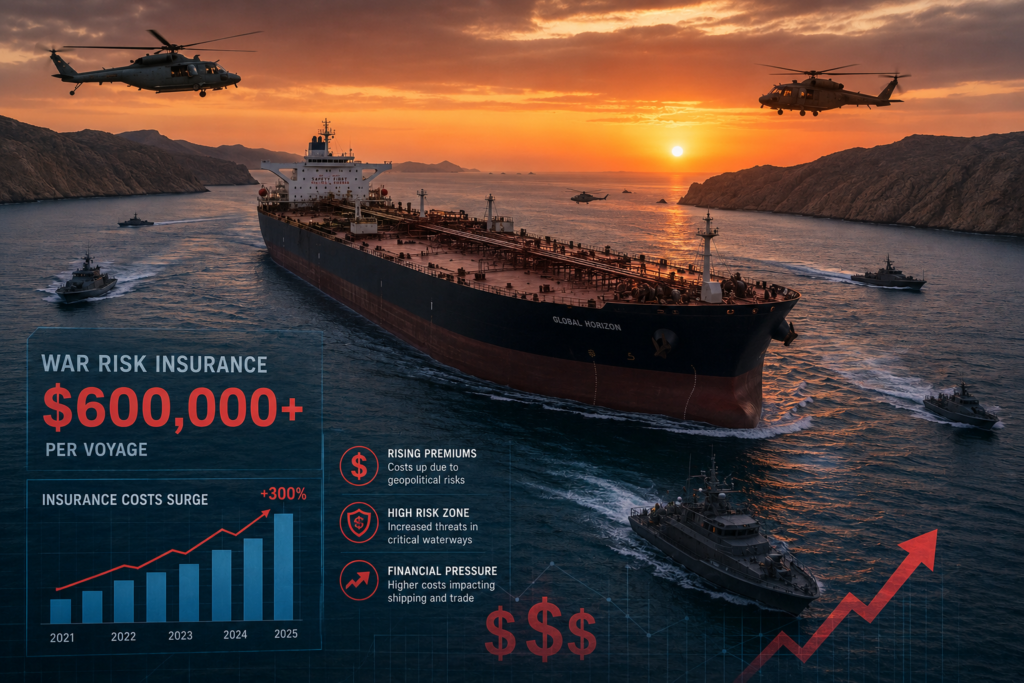
The rising tensions in the area have a massive impact on the financial side of shipping. Insurance acts as an invisible force that dictates whether ships can actually afford to use the Strait of Hormuz. When an area is deemed dangerous, the cost to insure a ship and its cargo rises dramatically.
The International Transport Workers’ Federation has designated the waterway as a High Risk Area. This classification changes the math for shipping companies in several ways.
- Sailors and ship crews have a legal right to refuse to sail into the area because of the danger.
- If crews do agree to make the trip, they must be paid extra danger money, which adds to the overall cost of the voyage.
- War risk insurance premiums can spike up past 0.4 percent of the total value of the ship’s hull for just a single crossing.
- For a large supertanker that is worth 150 million dollars, that 0.4 percent spike translates to an extra 600,000 dollars in insurance fees for one brief passage.
These extreme financial costs have forced some of the largest shipping giants in the world, including Maersk and MSC, to temporarily suspend their operations through the waterway at times, choosing to take longer routes instead.
8. Pipelines Cannot Completely Replace the Waterway
A common idea that people have is that nations can simply build pipelines across the land to bypass the Strait of Hormuz entirely during times of war or crisis. While pipelines do exist, they do not have the capacity to replace the water route.
Let us look at the actual numbers to see why this is a major issue.
- Saudi Arabia operates the East-West Pipeline, which moves oil across the country to the Red Sea.
- The United Arab Emirates operates the Abu Dhabi Pipeline, which carries oil to the Gulf of Oman, bypassing the narrow strait.
- When you combine the maximum capacities of both of these major pipelines, they can only move about 9 million barrels of oil per day.
Since the total amount of oil that needs to pass through the region is around 20 million barrels per day, these pipelines leave more than 11 million barrels with no alternative route. That remaining amount is more than 10 percent of the entire global demand for oil, meaning the world remains dependent on the physical waterway.
Recommend Read: 11 Major Cruise Ports in Asia
9. It is One of the Noisiest Underwater Environments on Earth
When you think of the ocean, you might imagine a peaceful and quiet underwater world. In the Strait of Hormuz, the reality is completely different. Oceanographers have discovered that this waterway is actually one of the loudest marine environments on the entire planet.
The noise is caused by a combination of heavy industrial and military activity.
- There is a non-stop, heavy vibration from the massive engines and propellers of hundreds of giant cargo ships and oil tankers passing through every week.
- Military ships operating in the area make extensive use of underwater sonar systems to scan for submarines and mines.
- This constant artificial noise fills the water and creates a chaotic acoustic environment.
This extreme noise pollution has a negative impact on the local marine life. Animals like dolphins and porpoises rely heavily on sound waves to communicate with each other, find food, and navigate through the water. The heavy underwater noise disrupts their natural senses and makes it difficult for them to survive.
10. It is Home to Heat-Resistant Super Corals
Despite the high amount of ship traffic and noise, the Strait of Hormuz and the surrounding Persian Gulf host some of the most resilient natural wonders in the world. The area is home to unique coral reefs known as super corals.
These corals have developed an incredible ability to survive in conditions that would kill regular reefs.
- Standard tropical corals usually experience bleaching and die when water temperatures stay above 32 degrees Celsius, which is about 90 degrees Fahrenheit.
- The super corals in this region thrive in water temperatures that regularly exceed 36 degrees Celsius, or 97 degrees Fahrenheit.
- They can handle temperatures that are two to three degrees Celsius higher than what most coral reefs around the world can tolerate.
Scientists believe that high salt levels, extreme summer heat, and cold winters over the last 15,000 years forced these corals to adapt rapidly. Marine biologists from institutions like NYU Abu Dhabi and the Australian Institute of Marine Science are currently studying the genetics of these corals to see if they can use their genes to help restore dying reefs globally, such as the Great Barrier Reef.
11. Large Marine Animals Use it as a Highway
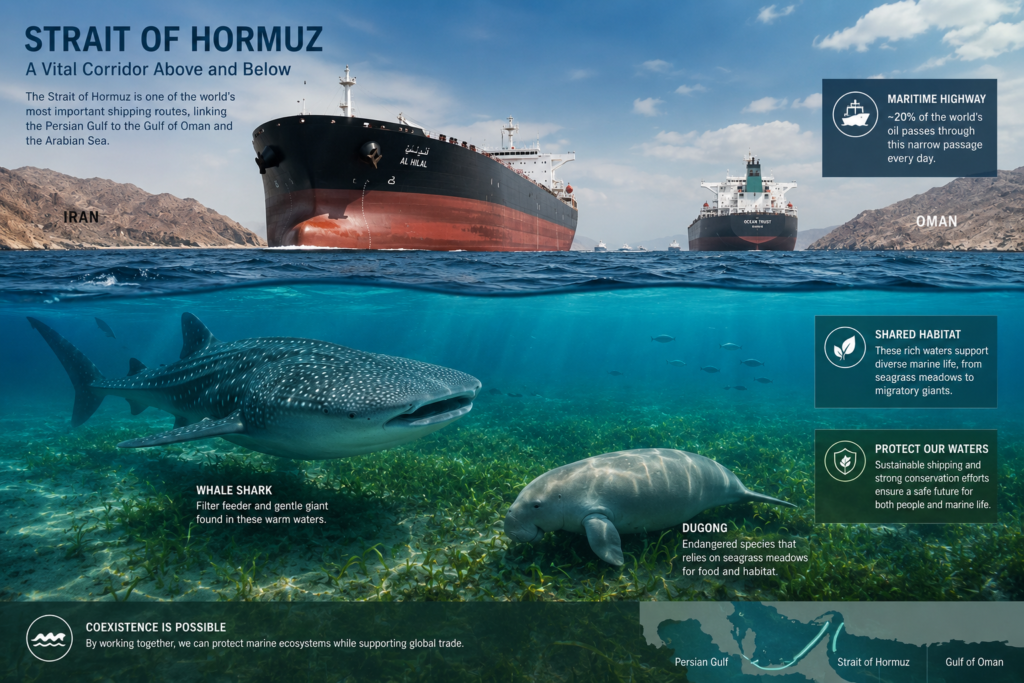
The waterway is also a vital natural corridor for large marine mammals and fish. Even though the lanes are crowded with industrial shipping, wildlife must pass through the same tight space to find food and raise their young.
The shallow waters near the strait contain a large amount of seagrass, which supports a variety of species.
- The region is home to the second-largest population of dugongs in the world, with the largest population residing in Australia. These gentle, plant-eating marine mammals spend their time grazing on the seafloor, but they are frequently disturbed by the heavy ship traffic and underwater noise.
- The strait serves as a vital migratory route for whale sharks, which are the largest fish species in the ocean.
- Satellite tracking data shows that these massive sharks swim right through the narrow channel to reach their feeding grounds in the gulf.
Because the whale sharks swim along the exact same pathways used by massive oil tankers, they are at a very high risk of being injured by spinning ship propellers or being killed in direct collisions with vessels.
Summary of Key Metrics
To help you visualize the scale and importance of this waterway, here is a quick look at the key data points discussed above.
| Feature / Metric | Detail |
| Narrowest Width | 21 miles (33 kilometers) |
| Daily Oil Volume | Around 20 million barrels |
| Global Oil Share | Roughly 20% of global consumption |
| Shipping Lane Width | 2 miles wide for each direction |
| Bypass Pipeline Capacity | 9 million barrels per day maximum |
| Super Coral Temperature Limit | Exceeds 36°C (97°F) |
A Final Look at the Waterway
The Strait of Hormuz is a unique combination of natural geography, global economics, and international tension. It is a place where ancient trade history meets modern energy demands, and where industrial supertankers share narrow lanes with endangered dugongs and heat-resistant corals.
Understanding the facts about this waterway helps you understand how interconnected our world truly is, and why a small stretch of water thousands of miles away can influence the prices you pay and the energy you use every single day.
Recommended Read: Top 15 Major Ports of the World: Updated Rankings, Insights & Emerging Hubs
Frequently Asked Questions
1. Where is the Strait of Hormuz located?
The Strait of Hormuz is located in the Middle East, positioned directly between the country of Iran to its north and the Musandam Peninsula, which is shared by Oman and the United Arab Emirates, to its south. It serves as the only water passage connecting the Persian Gulf to the open waters of the Gulf of Oman and the Arabian Sea.
2. Why is the Strait of Hormuz so important to the global economy?
This waterway is critical because roughly 20 percent of the world’s daily oil supply and massive amounts of liquefied natural gas must pass through it to reach international markets. Any disruption or closure of this narrow passage can instantly cause global energy supplies to drop and fuel prices to skyrocket.
3. Who controls the Strait of Hormuz?
Control of the waterway is shared between Iran and Oman under international maritime law, which grants ships from all nations the right to pass through for transit. However, due to its strategic northern coastline and ownership of key islands inside the strait, Iran maintains a heavy military and naval presence in the area.
4. How wide is the Strait of Hormuz at its narrowest point?
At its narrowest geographic point, the Strait of Hormuz is only about 21 miles, or 33 kilometers, wide. Within this narrow space, the actual shipping lanes used by large tankers are even tighter, with each direction being only two miles wide.
5. Can oil pipelines completely bypass the Strait of Hormuz if it closes?
No, existing pipelines across Saudi Arabia and the United Arab Emirates can only carry about 9 million barrels of oil per day combined. This leaves over 11 million barrels of oil per day with no alternative route except to travel by ship through the water passage.
